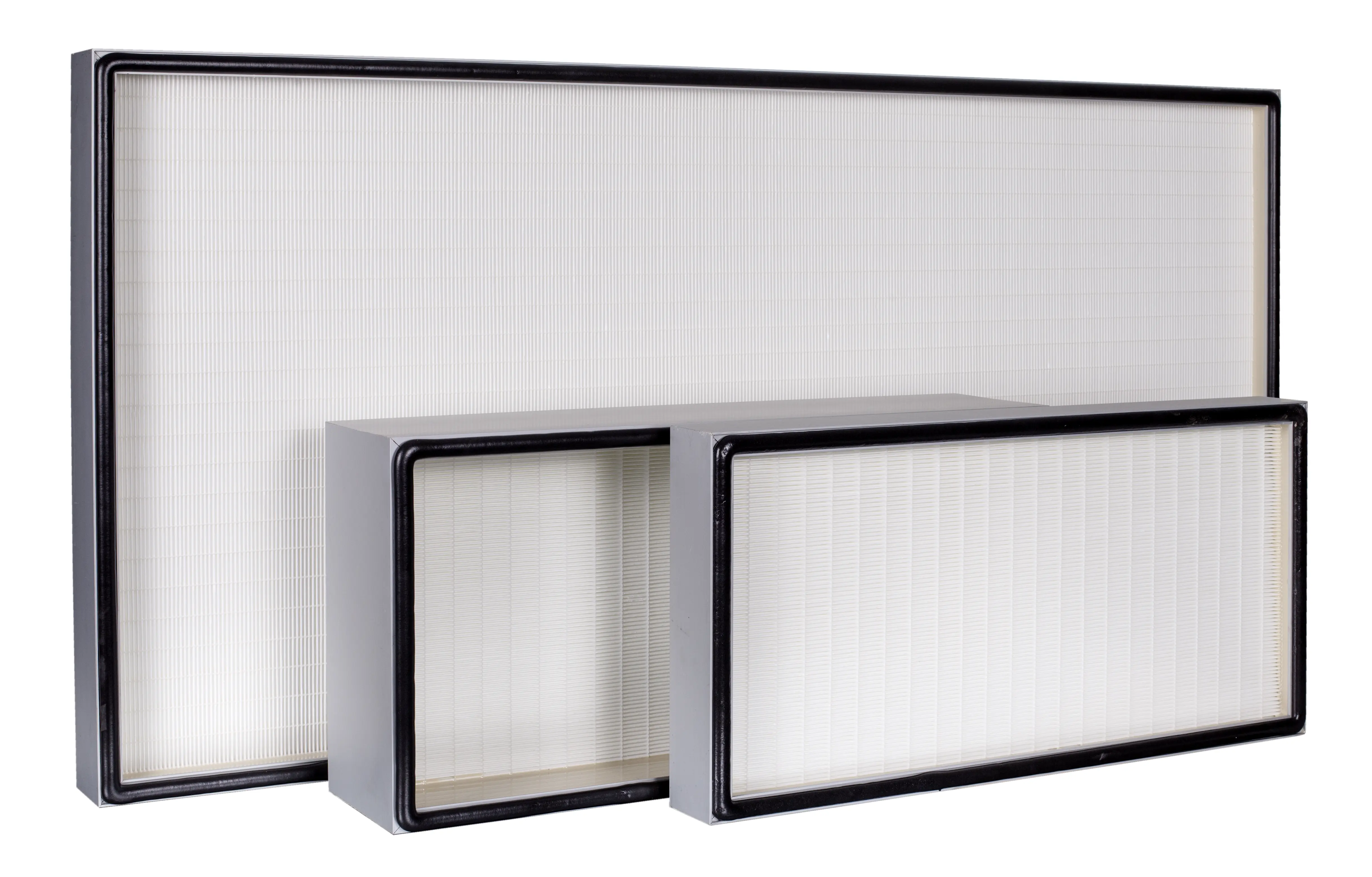
There is no single answer to the question of what a HEPA filter costs. Two filters with identical outer dimensions can differ in price by several times, because of differences that run from filter class through frame material to the test report supplied with them. This article works through the technical factors that determine the cost of a HEPA filter, so you can compare quotations properly and know what you are paying for.
Why Two HEPA Filters Can Differ So Much in Price
Price comparisons based on a description such as "610 x 610 x 292 HEPA filter" are usually misleading. That description gives only the outer dimensions. It says nothing about the efficiency class, the media area, the frame material, the seal type or whether the filter has been individually tested. Each of these affects both manufacturing cost and how the filter will perform in service.
A meaningful comparison starts by treating the filter not as a box, but as a component that delivers a defined efficiency at a defined airflow with a defined pressure drop.
1. Filter Class: H13, H14 and Above
Under EN 1822, the HEPA classes are H13 and H14. H13 filters achieve at least 99.95% overall efficiency at MPPS (the most penetrating particle size); H14 filters achieve at least 99.995%. The gap looks small on paper, but in terms of penetrating particles it is a factor of ten.
A higher class requires more media area to hold the same pressure drop, and tighter manufacturing tolerances. An H14 filter is therefore noticeably more expensive than an H13 of the same dimensions. Moving up to U15 and the ULPA classes widens the gap further.
The most common costing mistake here is specifying a higher class than the application needs. To match the class to the actual requirement, see our article on the differences between H13 and H14 HEPA filters.
2. Size and Depth: Standard or Custom?
Standard sizes suit series production and therefore carry a lower unit cost. Custom sizes require cutting, frame preparation and assembly to be set up for that specific job, which raises the cost per unit. The difference is most pronounced on small custom orders.
Depth is a separate cost item. Greater depth allows more media area inside the filter, which means a lower pressure drop at the same airflow. A 292 mm deep filter contains more material than a 78 mm mini-pleat panel and costs more — but its operating cost can be lower.
3. Frame Material
The frame determines both the price and the environments in which the filter can be used:
- MDF / plywood: The most economical option. Suitable for dry, room-temperature HVAC applications; not appropriate where humidity or disinfection is involved.
- Galvanised steel: The common industrial standard. Durable, with balanced cost.
- Aluminium: Light and corrosion resistant; an advantage in cleanroom ceiling systems and where filters are changed frequently.
- Stainless steel: Used in pharmaceutical, biotechnology and food production where a washable, disinfectable surface is required. The highest-cost option.
The frame is usually dictated by the constraints of the application rather than by price. For a detailed comparison, see MDF vs aluminium frame HEPA filters.
4. Seal Type: Gasket or Gel Seal?
However efficient the filter itself is, system efficiency falls if the joint between filter and housing leaks. There are two common solutions:
- Gasket (polyurethane seal): Standard, economical and adequate for most HVAC applications.
- Gel seal: A gel-filled channel in the filter frame seats onto a knife-edge profile in the housing. It provides far more reliable sealing in cleanroom ceilings and high-class applications, at a higher cost.
A gel seal raises the filter price but improves the likelihood of passing an integrity test, so it can lower total cost in facilities that require validation. For a comparison, see gel seal vs gasket seal HEPA filters.
5. Media and Separator Construction
Two basic constructions are used. In aluminium separator filters, aluminium spacers are placed between the pleats; the result is mechanically robust and suited to high-temperature applications. In mini-pleat construction, the pleats are separated by thin hotmelt beads or filament, which fits considerably more media area into the same volume and therefore gives a lower pressure drop.
The media itself is also a cost factor. The quality and grammage of the glass fibre media, and whether it is water repellent, are reflected in the price.
6. Testing and Certification
Under EN 1822, H13 and H14 filters must be individually tested and each filter must carry its own scan report. This testing requires measurement time per filter and laboratory capacity, and is reflected directly in the price.
This is the item most often omitted from conspicuously cheap quotations: the filter is sold as H14, but there is no individual scan report — only a reference to a type test. In a facility that requires validation, this becomes a risk of failing the on-site integrity test. Our article on HEPA filter integrity testing covers the subject in detail.
7. Quantity, Lead Time and Logistics
Unit cost falls as quantity rises, and this is particularly marked for custom sizes. Conversely, a request for a short lead time may raise the cost, since it requires priority placement in the production schedule.
HEPA filters are bulky and delicate. Transport and packaging account for a non-trivial share of total cost, especially for large-format, low-quantity orders.
Purchase Price Is Not the Same as Total Cost
A significant part of the cost a HEPA filter generates over its life is not the purchase price but the energy the fan spends overcoming it. A filter with a lower initial pressure drop and more media area may look expensive at purchase, yet close that gap through longer service life and lower energy consumption.
When comparing, evaluate three figures together: initial pressure drop at nominal airflow, recommended final pressure drop, and expected change interval. We examine this relationship in detail in HEPA filter pressure drop and energy cost.
What Information Is Needed for a Quotation?
To obtain a sound and comparable quotation, the following is enough:
- Filter class (H13, H14, or the application requirement you would like us to assess)
- Outer dimensions: width x height x depth (mm)
- Nominal airflow (m³/h)
- Preferred frame material, or the ambient conditions (humidity, temperature, disinfection)
- Seal type: gasket or gel seal
- Quantity and required lead time
- Whether an individual scan report is required
Safe Air manufactures HEPA filters in standard sizes as well as to project-specific dimensions. You can review the product range on our HEPA filters page, and contact us for selection and pricing suited to your application.
Frequently Asked Questions
The main technical factors are filter class (H13/H14), outer dimensions and depth, frame material, seal type, media and separator construction, whether an individual test report is supplied, and the order quantity and lead time. Two filters of identical outer size can be priced several times apart because of these differences.
H14 filters achieve at least 99.995% efficiency at MPPS, against 99.95% for H13. Reaching that efficiency while holding the same pressure drop requires more media area and tighter manufacturing tolerances, and the individual scan test is more demanding. These three factors raise the cost.
No fixed ratio applies; the difference depends largely on order quantity. On small custom orders, cutting, frame preparation and assembly setup are spread across few units, so unit cost rises noticeably. The gap closes quickly as quantity increases.
Conspicuously low quotations often omit the individual scan report, use less media area, or specify a frame and seal unsuited to the application. Less media area means higher pressure drop, therefore higher energy consumption and shorter service life. Total cost frequently differs from purchase price.
Filter class or application requirement, outer dimensions (width x height x depth in mm), nominal airflow (m³/h), frame material or ambient conditions, seal type, quantity, lead time, and whether an individual scan report is required. Quotations based on this information can be compared directly.