
Medium Filters

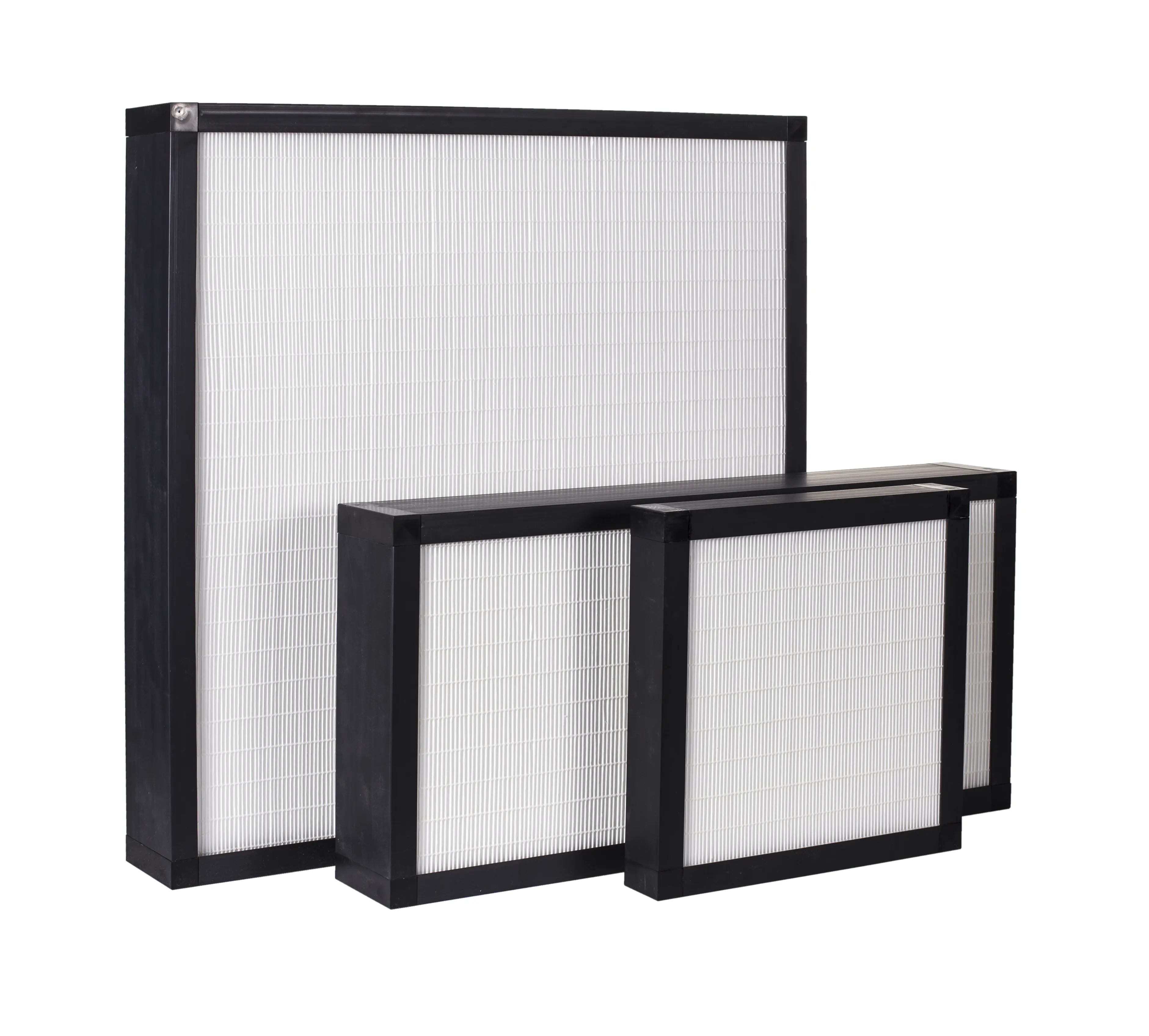


Medium filters are the main filter stage in most air handling units. They sit after the pre-filter and, where there is one, ahead of the HEPA stage. In a system without a HEPA stage they are the final filter, and the air quality delivered to the space depends on them.
What Belongs in This Category
| Format | Where it fits | Page |
|---|---|---|
| Bag filters (pocket filters) | The most common main stage. Large media area in a deep pocket; tolerant of dust loading | M5-M6-F7-F8-F9 Bag Filters |
| W compact filters | Same filtration duty in a shorter housing depth, with a rigid frame | W Compact Filters |
| Panel filters | Shallow installations and systems where the housing cannot take a deep filter | Panel Filters |
| Module filters | Multiple cells in one frame, for high airflow in a single opening | W Module Filters |
Choosing the Class: ISO 16890, Not EN 779
Air filters for general ventilation are classified under EN ISO 16890. The older EN 779 standard, which produced the familiar G4, M5, F7, F8 and F9 labels, was withdrawn on 11 July 2018.
The old codes are still used in conversation and still appear in specifications, so they have not disappeared from practice. But they describe a different measurement. ISO 16890 reports efficiency against the atmospheric particle fractions used in air quality work — ePM1, ePM2.5, ePM10 and Coarse — rather than against a single 0.4 µm test aerosol.
There is no exact conversion between the two. The standards use different test dust, a different particle range and different media conditioning. A filter's ISO class can only be established by testing it. Any table that presents a one-to-one equivalence is giving you a rule of thumb, not a specification.
What this means when you order: if your specification says "F7", ask the supplier for the ISO 16890 report for the specific model rather than accepting an assumed equivalent. Our guide on G4, M5, F7 filter classes sets out the detail.
Ask for the Discharged Value
Most synthetic filter media carry an electrostatic charge. That charge raises measured efficiency while the filter is new, then dissipates in service through humidity and captured dust.
ISO 16890 accounts for this by repeating the measurement on media conditioned with isopropanol and reporting that discharged value as well. This is the number that tells you what the filter will do in month eight, not in week one.
When you compare quotations, ask for both values. A filter quoted only on initial efficiency may settle to a noticeably lower level in service, and two filters with the same headline class can behave quite differently once the charge is gone.
Build the Stages, Not the Single Filter
Trying to solve everything with one filter loads that filter quickly and raises the running cost. A staged arrangement — coarse, then medium, then fine where required — costs less over a year and gives a longer service interval on the expensive stage.
A pre-filter ahead of the medium stage is the cheapest protection available for the stage behind it. Our pre-filter range covers panel, cassette and roll formats.
What We Need to Quote
- Filter class required by the specification, or the application if the class is open
- Width × height × depth, with units, and whether these are the filter or the housing opening
- Design airflow per filter, with units
- Acceptable initial pressure drop, and the final pressure drop at which you change filters
- Housing type and how the filter is held and sealed
- Operating temperature and humidity
- Quantity now, and estimated annual quantity if this is a recurring need
- Destination country
If you are replacing filters in an existing system, a photograph of the label on the filter currently fitted and the dimensions of the housing opening are usually enough to start.