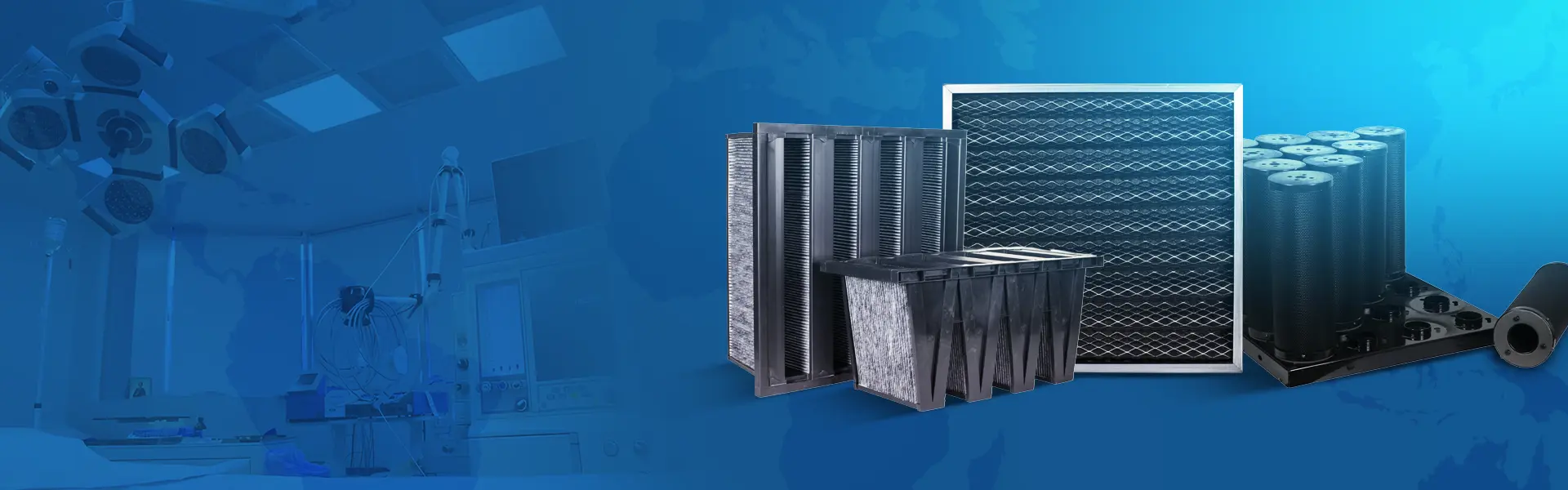
Activated Carbon Filters


Activated carbon filters remove gases, vapours and odours from an airstream by adsorption: molecules are held on the internal surface of the carbon rather than strained out mechanically.
This is a different job from particle filtration, and the two do not substitute for each other. A particle filter will not remove a solvent vapour. A carbon filter will not protect a cleanroom from particulate. Most installations that need both run them as separate stages, with the particle filter protecting the carbon.
What Belongs in This Category
| Format | Where it fits | Page |
|---|---|---|
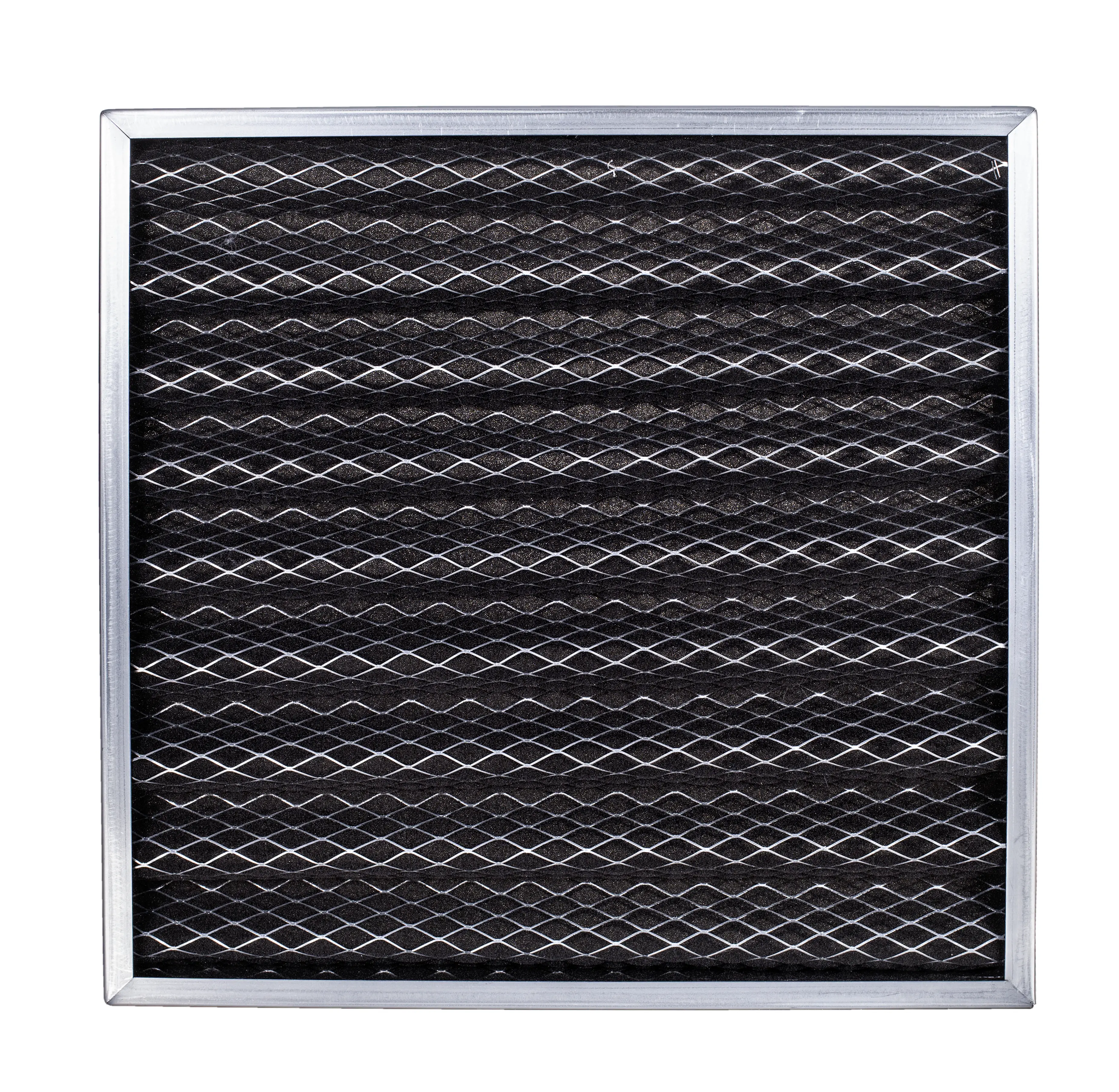
| Cassette / panel | Shallow housings; the usual retrofit format for adding a carbon stage to an existing system | Activated carbon cassette filters |
| Compact | Larger media volume in a deeper body, for higher airflow or higher gas load | Activated carbon compact filters |
| Cartridge | Cylindrical cartridges in a frame; the format for the highest carbon volume per face area | Activated carbon cartridge filters |
| Impregnated media roll | Continuous media for roll-type housings and spray booth exhaust | Activated carbon media rolls |
What Determines Whether a Carbon Filter Works
Carbon filter selection is driven by variables that are not on any product label. Getting these wrong is the usual reason a carbon stage underperforms.
Which gas. Activated carbon is not a general-purpose gas remover. Adsorption depends on the molecule: larger, heavier, less volatile organic molecules are held well, while small light molecules such as ammonia or formaldehyde are held poorly by plain carbon and need an impregnated media instead. The single most important thing you can tell us is which compound you are trying to remove. "Odour" is a symptom, not a specification.
Inlet concentration. The same filter behaves differently at 1 ppm and at 100 ppm. Concentration determines how quickly the carbon saturates, and therefore the service life and the cost per year.
Contact time. Adsorption needs the air to spend time in the carbon bed. Contact time is a function of bed depth and face velocity: push the airflow up and contact time falls, even though the filter and the carbon are unchanged. A carbon stage that is too shallow for its airflow will pass gas regardless of how good the carbon is.
Humidity. Water vapour competes with the target gas for adsorption sites. In a humid airstream, capacity for the gas you care about drops. High humidity is one of the most common reasons a carbon stage disappoints in service.
Temperature. Adsorption generally weakens as temperature rises, and desorption — the carbon releasing what it previously held — becomes a real consideration in hot airstreams.
Particle protection. Dust blinds the carbon surface and wastes capacity. A particle pre-filter ahead of the carbon stage is not optional in a dusty airstream; it is what makes the carbon economics work. See our pre-filter range.
Saturation: Carbon Fails Differently
This is the part most often missed in maintenance planning.
A particle filter tells you it is loaded: the pressure drop rises, and you change it when it reaches the final pressure drop. A carbon filter does not. Carbon saturates with almost no change in pressure drop, and the first sign is usually that the odour or the gas is back on the clean side.
So carbon service life cannot be managed from a pressure gauge. It has to be estimated from the gas load — concentration, airflow, operating hours and carbon quantity — and then confirmed in service by monitoring on the clean side.
If anyone offers you a carbon change interval without asking about your gas concentration and operating hours, that interval is a guess.
What We Will Not Tell You Without Data
We do not quote removal percentages or service life from a product name. Both depend on your gas, your concentration, your airflow and your humidity. A removal figure measured on one compound at one concentration does not transfer to another.
What we can do is work from the conditions you give us, tell you which media type suits the compound, and tell you what the stage arrangement needs to look like.
What We Need to Quote
The gas side — the part that matters most
- Which compound or compound group you need to remove
- Approximate inlet concentration, if measured
- Whether the load is continuous or intermittent
- Operating hours per day and days per year
The air side
- Design airflow, with units
- Available housing depth
- Operating temperature and relative humidity
- Whether there is a particle filter upstream, and its class
Commercial
- Width × height × depth, with units, and whether those are the filter or the housing opening
- Quantity now, and estimated annual quantity
- Destination country
If you do not have a measured concentration — most enquiries do not — describe the process and what the problem smells or behaves like, and tell us what is upstream. That is enough to narrow the media type and tell you what, if anything, needs measuring.
Frequently Asked Questions
Does an activated carbon filter remove particles? The carbon itself adsorbs gases and vapours. Any particle filtration comes from particle media built into the same product, not from the carbon. If you need both functions, confirm whether the product is a combined filter or whether you need two stages.
Does a HEPA filter remove odours? No. HEPA filters are particle filters. Odours and gases pass straight through. The two are separate stages with separate jobs.
Will activated carbon remove any gas? No. Plain activated carbon works well on larger, less volatile organic molecules and poorly on small light molecules. Some compounds need impregnated media. This is why we ask which compound you are dealing with before recommending anything.
How long does a carbon filter last? It depends on the gas load, not on the calendar. Saturation does not raise the pressure drop, so the interval has to be estimated from concentration, airflow and operating hours, then confirmed by monitoring the clean side.
Can activated carbon be regenerated? Industrial carbon regeneration exists as a process, but whether it is practical for a given filter depends on the media, the adsorbed compound and the filter construction. Ask us about the specific product rather than assuming either way.
Do you supply water filtration? This page covers air filtration. If you have a water treatment requirement, ask us directly rather than assuming from the carbon media — the products on this page are specified for airflow.