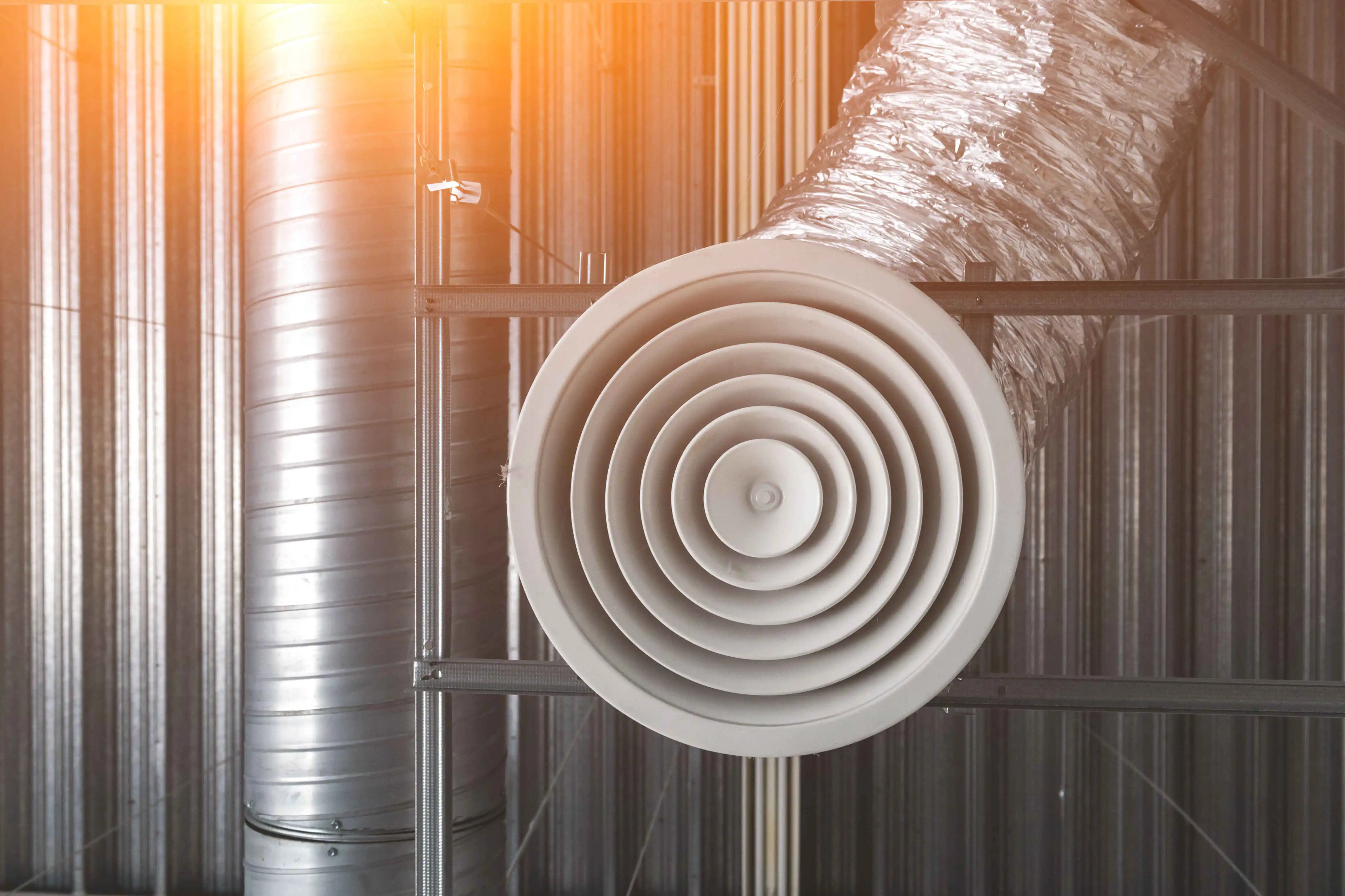
An industrial air filter is a filtration component used to remove dust, particles, aerosols, fibres, odours or specific airborne contaminants from air streams in industrial, commercial and controlled environments. Unlike the basic ventilation filters used in small indoor units, industrial air filters are selected against technical requirements: airflow, filter class, pressure drop, contamination load, operating temperature, humidity and installation dimensions.
This guide covers what industrial air filters are, how industrial air filtration systems are built in stages, which filter types belong in which stage, how to select them, where filtration reaches its limits and what information a supplier needs to quote accurately. Safe Air is the manufacturer reference used throughout.
What Does an Industrial Air Filtration System Do?
Industrial air filters work by passing contaminated air through a filter media. As the air moves through the media, particles are captured on the surface or inside the fibre structure. The cleaned air then continues to the ventilation system, production area or controlled environment.
The mechanism depends on the filter type and the application. A panel filter captures larger dust in a general HVAC system, while a HEPA filter may serve as the final stage in a cleanroom or healthcare ventilation system. Activated carbon filters work differently: they are selected for odour, gas and vapour control rather than particle filtration. A particle filter does not remove gases, and a gas-phase filter does not replace particle filtration.
The main functions across applications are:
- Particle removal: captures dust, fibres, aerosols and airborne particles.
- Equipment protection: helps protect fans, coils, ducts, air handling units and sensitive machinery.
- Process protection: reduces contamination risk in production and controlled environments.
- Indoor air quality support: helps improve air quality in commercial and industrial buildings.
- Final filtration: provides high particle retention in critical applications where HEPA or ULPA filters are used.
The Three Filtration Stages in an Industrial System
In professional HVAC systems, cleanrooms, hospitals, laboratories and production facilities, filtration is planned in stages rather than with a single filter. The three stages are pre-filtration, fine filtration and final high-efficiency filtration. Each has a distinct role, and selecting them together is what makes a system stable.
1. Pre-filtration
Pre-filtration is the first stage in most industrial ventilation and HVAC systems. Its purpose is to capture larger dust particles before the air reaches more sensitive, higher-efficiency filters, which protects the downstream stages from excessive dust loading and extends their service life.
Pre-filters are used in air handling units, commercial buildings, factories, warehouses, production areas and general ventilation. They are selected according to dust load, airflow rate, dimensions, frame structure and replacement frequency. Common types are panel filters, coarse filters, metal filters, washable filters and grease filters for specific extraction applications.
If pre-filtration is omitted, higher-efficiency filters clog faster, pressure drop rises earlier and the ventilation system loses airflow performance.
2. Fine filtration
Fine filtration captures the smaller particles that pass the pre-filter stage. It improves air quality and prepares the air for final filtration where a HEPA or ULPA filter is used. This stage matters most where air cleanliness, system protection and energy performance have to be balanced.
Common types are bag filters, compact filters, rigid filters, high-efficiency panel filters and V-bank filters. Selection depends on filter class, airflow, pressure drop, pocket depth, media area and installation conditions. The wrong fine filter increases energy consumption, reduces airflow or shortens the life of the final filters.
3. Final high-efficiency filtration
Final filtration is used where high particle retention is required. This stage covers HEPA filters and ULPA filters, installed as the last stage in cleanrooms, hospitals, laboratories, pharmaceutical production, electronics manufacturing and other controlled environments.
Final filters are selected according to the required cleanliness level, filter class, sealing method, airflow, pressure drop and documentation needs. Depending on the project specification, H13 or H14 HEPA filters, gel seal HEPA filters or terminal HEPA filters may be preferred. A final filter should never be selected by size alone: class, airflow, initial and final pressure drop, sealing requirement and installation conditions have to be evaluated together. A filter class on its own is not a cleanroom classification and not a proof of regulatory compliance; those are established by the installed system and its validation.
| Filtration stage | Main purpose | Common filter types | Typical applications |
|---|---|---|---|
| Pre-filtration | Captures larger dust and protects downstream filters | Panel filters, coarse filters, metal filters | HVAC systems, factories, commercial ventilation |
| Fine filtration | Captures smaller particles and improves air quality | Bag filters, compact filters, rigid filters, V-bank filters | Air handling units, production areas, hospitals, laboratories |
| Final high-efficiency filtration | Provides high particle retention for controlled environments | HEPA filters, ULPA filters, gel seal filters, terminal filters | Cleanrooms, pharmaceutical facilities, healthcare, sensitive manufacturing |
Multi-stage filtration distributes particle loading across the system: larger particles are captured first, smaller particles next, and critical fine particles at the final stage. This supports longer filter life, more stable airflow and more predictable air quality than a single-filter design.
Common Industrial Air Filter Types
| Filter type | Main function | Typical application |
|---|---|---|
| Panel filter | Pre-filtration and coarse dust capture | HVAC systems, air handling units, general ventilation |
| Bag filter | Fine filtration with higher dust holding capacity | Commercial buildings, factories, air handling units |
| Compact filter | High-efficiency filtration in limited installation depth | Industrial HVAC systems, production areas |
| Cassette filter | Compact pleated construction for varied classes | Air handling units, extraction systems, equipment |
| HEPA filter | Final high-efficiency particle filtration | Cleanrooms, hospitals, laboratories, pharmaceutical facilities |
| Activated carbon filter | Odour, gas and vapour control | Laboratories, HVAC systems, process ventilation |
| Custom air filter | Project-specific size, frame or seal | OEM systems, special equipment, replacement projects |
The cassette filter and filter housing ranges matter in retrofit work, where the element has to match an existing seating surface rather than a catalogue size.
Where Industrial Air Filters Are Used
HVAC systems and air handling units
Panel, bag, compact and V-bank filters are selected according to airflow, available installation depth and pressure drop budget. In air handling units the stage layout usually matters more than the individual element.
Cleanrooms
Cleanrooms require controlled particle levels. Pre-filters and fine filters are used ahead of final HEPA or ULPA filtration. Filter class, sealing method, airflow distribution and documentation requirements all need to be defined before purchase.
Hospitals and laboratories
Hospitals and laboratories may require high-efficiency filtration depending on risk level and ventilation design. HEPA filters, terminal HEPA filters and gel seal HEPA filters are used in critical areas where controlled air quality is required.
Pharmaceutical and food production
In pharmaceutical and food production, correct filter selection reduces airborne contamination and supports process reliability. Documentation expectations are usually higher than in general ventilation.
Power generation and heavy industry
Gas turbine intakes, compressor rooms and process ventilation in heavy industry work with high dust loads and often with temperature or humidity extremes. Dust holding capacity and frame durability carry more weight here than in commercial HVAC.
OEM equipment
Equipment manufacturers may require filters built to specific dimensions, airflow values, frame materials and sealing requirements. In these projects a technical drawing and the system data are what make accurate production possible.
Industrial Air Filter Selection Criteria
Selecting an industrial air filter by size alone is not enough. The filter has to match the system design and the real operating conditions:
- Application: HVAC, cleanroom, laboratory, production area, healthcare facility or OEM equipment.
- Filter class: stated together with its standard. A class written without its standard cannot be evaluated.
- Airflow rate: stated per element and for the whole unit, since these are frequently confused.
- Pressure drop: initial and final values, each with the airflow they refer to. A pressure drop figure without an airflow and a face size cannot be compared.
- Dimensions: width, height and depth compatible with the housing, in mm, in that order.
- Frame material: MDF, aluminium, galvanised steel, stainless steel or plastic according to the application.
- Seal type: gasket, gel seal or another sealing arrangement, with the gasket position stated.
- Operating conditions: temperature, humidity, chemical exposure and dust load.
- Documentation: datasheets or test evidence where a controlled environment requires it.
Where a legacy classification is quoted, ask for the relevant test evidence instead of assuming an exact conversion between standards. Equivalence between an older class and a newer one is not a fixed one-to-one relationship, and treating it as one is a common source of mismatched deliveries.
Do Industrial Air Filtration Systems Actually Work?
They work when the system is selected, installed and maintained for the application. Filter type, filter class, airflow, pressure drop, system design, sealing quality and the maintenance schedule all affect the result. The useful question is therefore not whether filtration works, but whether the selected configuration matches the contaminant and the operating conditions.
Where filtration helps:
- Airborne dust reduction: less dust, smoke and aerosol load in the treated air stream.
- Equipment and process protection: cleaner coils, ducts and production surfaces.
- Controlled environments: HEPA final filtration supports particle control in healthcare, laboratory and cleanroom ventilation.
- Odour and gas reduction: activated carbon stages address vapour-phase contaminants that particle filters do not.
Where it reaches its limits:
- Particle filters do not remove gases. HEPA filters are designed for particles; odours, gases and vapours need a gas-phase stage.
- Sizing governs performance. An element that does not suit the airflow requirement reduces system performance regardless of its class.
- Maintenance governs efficiency. A loaded filter raises pressure drop, reduces airflow and lowers system efficiency.
- Bypass defeats the class. Air that passes around a filter through a poor seal or a distorted frame is not filtered at all, which is why sealing quality matters as much as the element.
- Sources may need controlling first. Where contaminants are generated at a point, local extraction reduces the load before it reaches the central system.
Air Treatment Methods Used Alongside Filtration
Industrial air purification is often discussed as if it were a single product. In practice several methods are combined, and mechanical filtration is the stage that most of the others depend on:
- Mechanical filtration: the primary stage for particles, covering pre-filters, fine filters and HEPA or ULPA final filters.
- Activated carbon filtration: adsorption for odours, gases and volatile organic compounds.
- Air scrubbers: wet or dry systems used where process emissions must be treated before release or recirculation, common in metal processing, cement and chemical production.
- UV-C treatment: used as a supporting stage for microbial control in some pharmaceutical, food and laboratory applications. Its effect depends on airflow, exposure time, system design and maintenance.
- Ionisation: evaluated in electronics, textile and controlled environments as a supporting technology. It does not replace mechanical filtration.
- Source capture: fume hoods, extraction arms and downdraft tables collect contaminants where they are generated, which is particularly relevant in welding, painting, metal fabrication and dust-generating operations.
- Monitoring: particulate levels, VOC concentration, temperature, humidity, differential pressure across filters and airflow performance. Monitoring is how filter loading and ventilation faults are detected before they affect production.
Facilities subject to emission or workplace exposure requirements usually need a combination: particle filtration, a gas-phase stage and source capture, matched to the contaminant mix rather than selected one at a time.
Common Mistakes in Industrial Filtration
- Selecting a filter only by width, height and depth.
- Ignoring airflow and pressure drop values, or quoting one without the other.
- Installing a final HEPA filter without adequate pre-filtration.
- Choosing a filter class that does not match the application requirement.
- Assuming a fixed conversion between an older and a newer classification.
- Ignoring temperature, humidity, chemical exposure and dust load.
- Using standard sizes in systems that need custom elements.
- Requesting a quotation without a drawing or system data, then comparing offers that do not cover the same scope.
Standard and Custom Industrial Air Filters
Some systems can use standard filter sizes; others need custom dimensions or a special frame design. Custom elements are common in OEM equipment, replacement projects, non-standard air handling units and special production systems. They can be built to width, height, depth, filter class, airflow, frame material, gasket type and technical drawing, which improves installation compatibility and reduces the risk of a filter that fits the opening but not the system.
Safe Air manufactures industrial air filters across these stages: panel filters, bag filters, compact filters, cassette filters, HEPA filters including H13 and H14, ULPA filters, activated carbon filters, V-bank filters, gel seal and terminal HEPA filters, and custom-sized elements. Working directly with the plant that manufactures the element is what makes a drawing-based or non-standard requirement practical to resolve, because the dimensional and sealing questions are answered by the people who build the frame.
What to Send for a Quotation
An industrial air filter should be selected against the real operating conditions of the system, and the stages should be evaluated together rather than one element at a time. To get a comparable quotation, send:
- Site and air handling unit reference, and the filtration stage concerned.
- Existing part number and a photograph of the old label where available.
- Outside dimensions as width x height x depth in mm.
- Required filter class together with its standard.
- Design airflow, stated per element and for the unit.
- Quantity, frame material, gasket position and seating surface or housing drawing.
- Operating temperature, humidity and known dust or chemical load.
- Any documentation the project requires.
Leave unknown fields clearly marked rather than estimating them, and ask the supplier to list the assumptions behind the offer. Comparing confirmed technical scopes first, and price and delivery afterwards, is what keeps an apparently attractive offer from hiding an unresolved interface.
Request a technical quotation · Our air filter manufacturing in Turkey · Catalogues and technical documents
Frequently Asked Questions
A filtration component that removes dust, particles, aerosols, fibres, odours or specific contaminants from an air stream in industrial, commercial or controlled environments. It is selected against airflow, filter class, pressure drop, dimensions and operating conditions rather than size alone.
An industrial system is normally staged: pre-filtration captures larger dust, fine filtration captures smaller particles, and final HEPA or ULPA filtration is used where high particle retention is required. Staging distributes the dust load, which supports longer filter life and more stable airflow than relying on one element.
Particle filters, including HEPA filters, are designed for particles and do not remove gases. Odours, gases and vapours require a gas-phase stage such as an activated carbon filter, selected according to the target compound and the operating conditions.
Air that passes around the element through a poor seal, a distorted frame or an uneven seating surface is not filtered at all. A high filter class cannot compensate for bypass, which is why gasket position, seal type and the housing surface have to be confirmed with the filter selection.
Unit reference and filtration stage, outside dimensions in mm as width x height x depth, filter class with its standard, design airflow per element and for the unit, quantity, frame material, gasket position, operating conditions and any required documentation. Unknown fields should be marked as open rather than estimated.