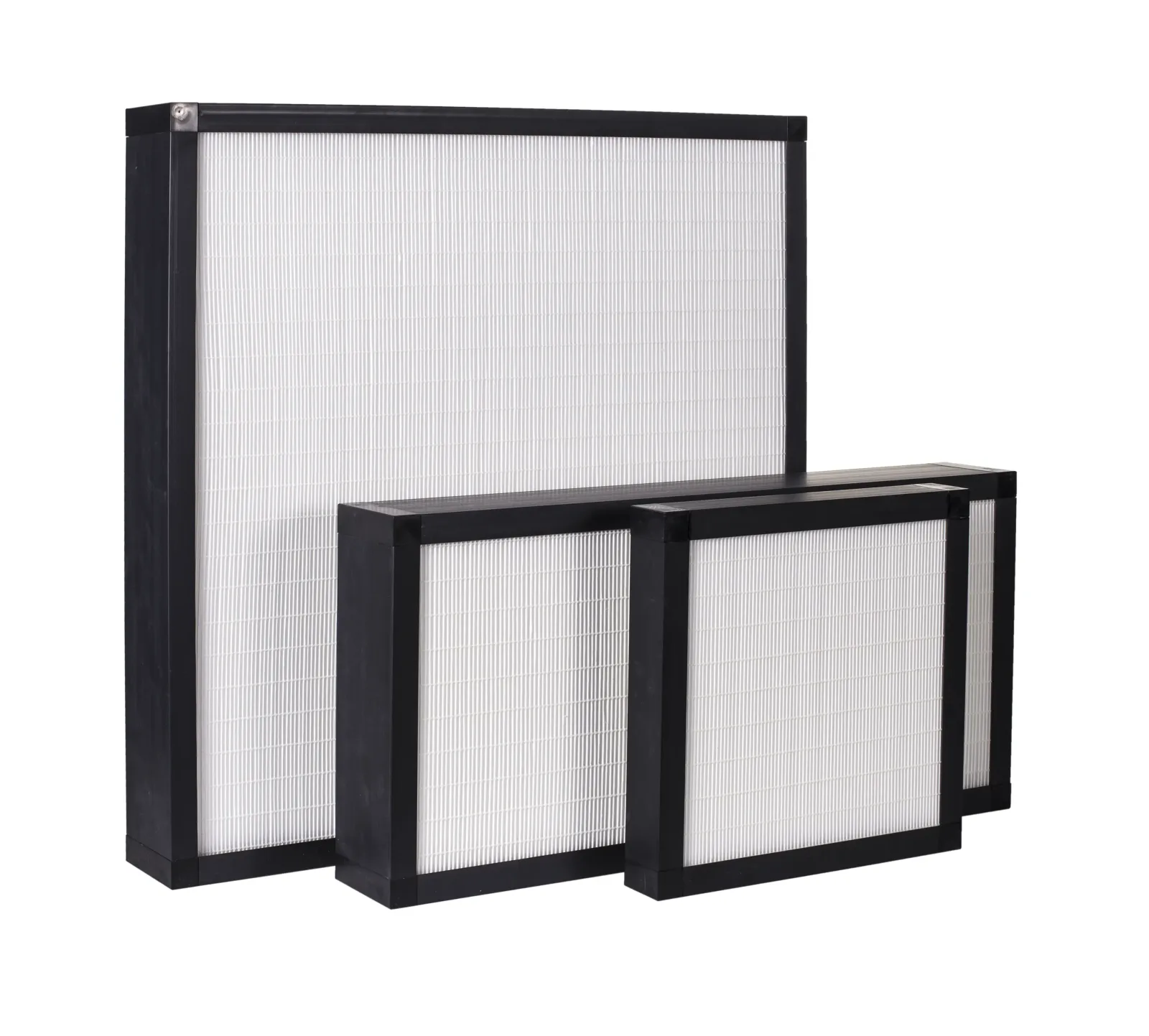
The Short Answer: A 600 x 600 Filter Is Actually 592 x 592
This is the most common confusion in cassette filter sizing. What the industry calls a "600 x 600 filter" usually has an actual outer dimension of 592 x 592 mm. The 600 mm figure is the nominal size, describing the notional dimension of the housing slot; the filter is made slightly smaller so that it fits.
When ordering, therefore, state which measurement you are giving: the outer dimension of the filter, or the internal dimension of the housing slot? That single sentence prevents most installation problems on site.
How Dimensions Are Expressed
Cassette filter dimensions are always given as width x height x depth, in millimetres. In a specification such as 592 x 592 x 48 mm, the first two values describe the filter face and the third its depth in the direction of airflow.
Unlike HEPA filters, cassette filters are generally supplied without a gasket; they seat into a rail or slide system in the housing. Sealing is achieved not by gasket compression but by the close tolerance between filter frame and slot. A dimensional error here translates directly into bypass.
Common Standard Sizes
The face dimensions most frequently used in air handling units and general ventilation:
| Nominal | Actual outer size | Use |
|---|---|---|
| 600 x 600 | 592 x 592 mm | The most common full module; filter walls in AHUs |
| 300 x 600 | 287 x 592 mm | Half module; wall edges and narrow sections |
| 500 x 500 | 490 x 490 mm | Small air handling units, cabinets |
| 400 x 500 | 395 x 495 mm | Hood and small unit applications |
| 500 x 500 | 495 x 495 mm | Kitchen hood metal filter |
Common as these are, they are not obligatory. In an existing facility the housing may match none of them, and custom manufacturing then becomes relevant.
Depth: The Distinguishing Dimension of a Cassette Filter
Cassette filters are markedly shallower than HEPA filters. Common depths are:
- 20–25 mm: Fan coil and small equipment filters, generally flat or shallow pleated.
- 45–50 mm: The most common pre-filter depth in air handling units. Z-type pleating provides a good media area at this depth.
- 96 mm: High dust load environments and applications where longer life is required. Deep pleating gives a considerably larger media area.
As depth increases, so does the media area that fits inside the filter — meaning lower face velocity at the same airflow, lower pressure drop and longer service life. The choice between 48 mm and 96 mm is usually dictated by available space, but where space exists the deeper option lowers operating cost.
We cover the relationship between pressure drop and energy cost in cassette filter prices.
The Relationship Between Size and Nominal Airflow
The airflow a cassette filter can carry is the product of its face area and the face velocity. Typical rated face velocity for cassette filters is around 2.5 m/s.
On that basis a 592 x 592 mm filter has a face area of roughly 0.35 m² and is typically rated at a nominal airflow of 3,000–3,400 m³/h. A 287 x 592 mm half module carries approximately half of that.
These figures vary with media type, class and depth; the product data sheet is the authority for any specific item. The principle is what matters: operating above nominal airflow raises pressure drop sharply, shortens service life, and at high face velocity can cause captured particles to be re-entrained into the airstream.
Filter Walls: Do Not Think of Size as a Single Filter
In large air handling units filters are installed not individually but as a filter wall — for example twelve 592 x 592 filters in a 3 x 4 arrangement. The sizing decision then has two layers.
First, how many full modules fit the housing cross-section is established. Where the edges leave gaps too small for a full module, these are closed either with half modules (287 x 592) or with custom-size filters. Blanking them off with a plate is common but wrong — it narrows the flow cross-section and raises the face velocity through the remaining filters.
Common Mistakes When Taking Measurements
- Treating the nominal size as the actual size. A filter ordered as "600 x 600" and made at 600 x 600 will not fit the slot.
- Reporting the housing slot's internal dimension as the filter's outer dimension. The filter either jams or sits too loosely and air bypasses it.
- Copying the old filter's label without measuring. The label may show a nominal size while the actual size differs — and the previous filter may itself have been wrongly specified.
- Omitting depth. Ordering on face dimensions alone leaves performance entirely undefined.
- Ignoring the rail system. In slide systems the frame thickness must also suit the rail width.
- Forgetting the effect of humidity. A cardboard frame swells in humid conditions and its dimensions change; plastic or galvanised steel should be chosen instead for humid applications.
When Is a Custom Size Required?
- When the existing housing cross-section does not divide evenly into standard modules
- When the edge rows of a filter wall cannot take a full module
- When imported equipment uses dimensions that do not align with local standards
- When a fan coil or special cabinet requires a shallow, non-standard depth
- When an equipment manufacturer (OEM) specifies a size particular to its own unit
The critical point with custom sizes is not to stop at making the filter fit. When dimensions change, face area and media area change with them, and nominal airflow and pressure drop must be reassessed.
What to Provide When Specifying Dimensions
- Width x height x depth (mm), and whether this is the filter outer dimension or the slot internal dimension
- Filter class (ISO 16890 class, or the former EN 779 code)
- Nominal airflow (m³/h), or the unit's total airflow and the number of filters
- Frame material or ambient conditions
- Mounting type: rail/slide, framed slot, or free seating
- A photograph of the existing filter and its label, if available
Safe Air manufactures cassette filters in standard sizes and to project-specific dimensions. Review the range on our cassette filters page, and contact us for dimensional assessment and quotations.
Frequently Asked Questions
Usually 592 x 592 mm. The 600 mm figure is the nominal size describing the notional dimension of the housing slot; the filter is made slightly smaller so that it fits. When ordering, state whether you are giving the filter's outer dimension or the slot's internal dimension.
The most common depths are 20–25 mm (fan coils and small equipment), 45–50 mm (the standard pre-filter depth in air handling units) and 96 mm (high dust load environments and applications requiring longer life). Greater depth means more media area, which gives lower pressure drop and longer service life.
Its face area is roughly 0.35 m², and since typical rated face velocity for cassette filters is around 2.5 m/s, nominal airflow is generally rated at 3,000–3,400 m³/h. The exact figure varies with media type, class and depth; consult the product data sheet.
Treating the nominal size as the actual size. A filter ordered as "600 x 600" and manufactured at 600 x 600 will not fit the slot. The second common error is reporting the housing slot's internal dimension as the filter's outer dimension, which leaves the filter either jammed or loose enough for air to bypass it.
Gaps too small for a full module should be closed with half modules (287 x 592) or custom-size filters. Blanking them off with a plate is common but wrong: it narrows the flow cross-section and raises face velocity through the remaining filters, increasing pressure drop and shortening their life.