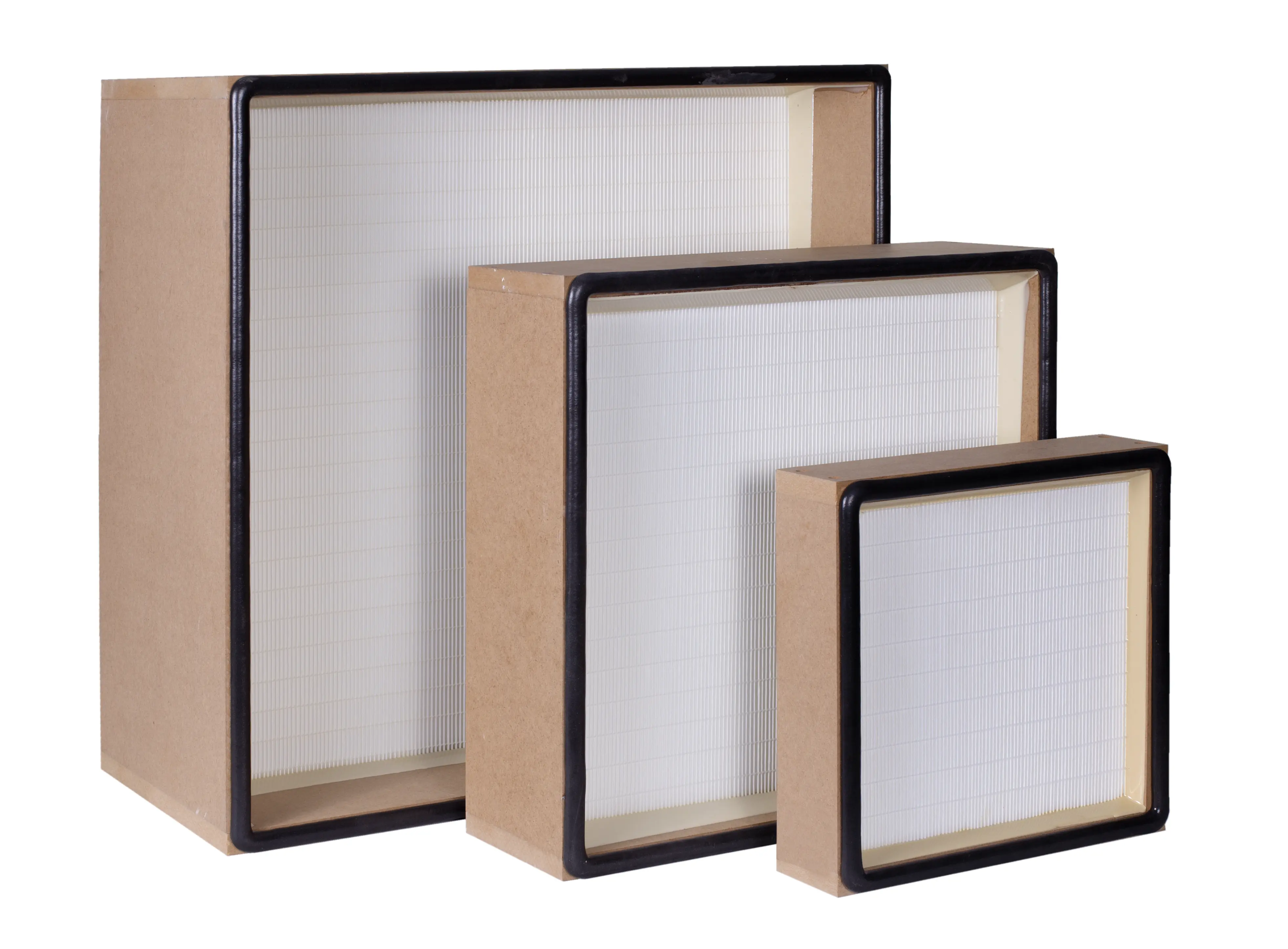
When the cost of HEPA filters comes up in an industrial facility, one of the first questions asked is whether they can be washed and reused. The short answer is no — and the reason is more fundamental than is usually assumed. This article explains why a genuine HEPA filter cannot be cleaned, what products sold as "washable HEPA" actually are, and the approach to reducing cost that does work.
The Short Answer: An EN 1822 Class HEPA Filter Cannot Be Washed
A HEPA filter certified to class H13 or H14 under EN 1822 cannot be washed, and after washing it cannot be assumed to hold its class. This is not a usage recommendation but a limit arising from the physical structure of the media.
Washing a HEPA filter often makes it look clean while irreversibly degrading its filtration performance. A restored appearance does not mean the filter is working.
Why It Cannot Be Washed: The Structure of Glass Fibre Media
HEPA media is produced by bonding sub-micron diameter glass fibres into a randomly oriented, very fine web. Filtration depends on the pore structure and fibre distribution of that web. Particles are captured not only by sieving but through inertial impaction, interception and diffusion.
This structure is not designed to withstand water. When the media becomes wet:
- The binder between fibres softens, the fibre distribution shifts and the pore structure changes irreversibly.
- During drying, fibres adhere to one another and clump; the media compacts in some areas while openings invisible to the eye form in others.
- Those openings may look negligible in terms of overall efficiency, but they appear directly as leaks in an MPPS scan.
There is also a microbiological problem. Media that stays wet, or does not dry completely, becomes a favourable environment for microbial growth together with the organic load it has captured. In hospital, pharmaceutical and food applications this alone is sufficient grounds against it.
We describe the media structure and the measurement on which classification rests in HEPA filters and the EN 1822 standard.
What Are Products Sold as "Washable HEPA Filters"?
Products marketed as "washable HEPA", particularly in domestic appliances, generally fall into one of two categories:
- Low-efficiency filters with synthetic media. Based on polyester or polypropylene, these tolerate water better than glass fibre but do not fall into class H13 or H14 under EN 1822. Their efficiency is generally far lower.
- Items described as "HEPA type" or "HEPA like". These are not standardised terms; they indicate the product is not certified to EN 1822.
In industrial filtration, in a cleanroom, or in any facility requiring validation, such products cannot substitute for HEPA. The only evidence that a filter genuinely is H13 or H14 is an individual scan report produced in accordance with EN 1822.
Why Vacuuming or Compressed Air Causes Damage
Two other methods are frequently attempted besides washing, and neither is less damaging.
Compressed air reverses the direction of flow and stresses the media against the direction it was designed for. The fine fibre web does not have the strength to withstand that pressure; the result is pinhole-sized openings, invisible to the eye but unmistakable in a scan test. The dislodged particles are also released back into the environment.
Vacuum cleaning can remove coarse surface dust and lower pressure drop somewhat. This is misleading: a fall in pressure drop does not mean the filter has improved. Particles embedded in the depth of the media are not removed, while the brush and suction cause mechanical damage. Pressure drop falls, and so does efficiency.
In both cases the filter becomes a component whose certification can no longer be assumed valid. In a facility where on-site integrity testing is performed, this means failing the test. We cover the subject in HEPA filter integrity testing.
The Stage That Really Can Be Maintained: The Pre-Filter
In a correctly configured filtration system, the HEPA filter is not the first stage to meet dirty air. One or two coarse filter stages sit ahead of it. These pre-filters capture coarse dust, fibres and large particles, significantly reducing the load on the HEPA.
Pre-filters are inexpensive and replaced regularly; some synthetic types can be cleaned to a limited extent. The most effective and cheapest way to extend the life of a HEPA filter is not to attempt to clean it but to specify the pre-filter stage correctly and replace it on time.
Where the pre-filter is neglected, the HEPA filter is forced to capture coarse dust, its pressure drop rises rapidly, and the far more expensive HEPA is replaced earlier than necessary.
So When Should a HEPA Filter Be Replaced?
The replacement decision is made by measurement, not by calendar. The governing indicator is pressure drop. The initial pressure drop is recorded when the filter is installed; as it loads, that value rises. The filter is replaced when the manufacturer's recommended final pressure drop is reached.
Beyond that, the following require replacement regardless of schedule:
- A leak found during integrity testing that exceeds the repair limit
- Visible damage, perforation or separation of the media from the frame
- Wetting through water contact, flooding or condensation
- An abnormal event such as fire, smoke or a chemical release
How to monitor pressure drop and its relationship to energy cost is covered in HEPA filter pressure drop, and replacement timing in HEPA filter replacement time.
The Approach to Reducing Cost That Actually Works
Washing a HEPA filter does not reduce cost; it creates an unmeasured risk. The approach that genuinely reduces cost is this:
- Configure the pre-filter stage properly. This is the single intervention that most extends HEPA filter life.
- Select the class according to need. An H14 the application does not require raises both purchase and energy cost unnecessarily.
- Choose a filter with adequate media area. A deeper filter with more media area runs longer at a lower pressure drop.
- Monitor pressure drop. Replacing a filter early is as costly as replacing it late; measurement prevents both.
Safe Air manufactures H13 and H14 HEPA filters supplied with an individual test report in accordance with EN 1822. Review the products on our HEPA filters page, and contact us for the filter and pre-filter stage suited to your system.
Frequently Asked Questions
No. A HEPA filter certified to class H13 or H14 under EN 1822 cannot be washed. When glass fibre media becomes wet, the binder softens and the fibre distribution and pore structure are irreversibly altered; micro-openings formed during drying appear as leaks in a scan test. A washed filter cannot be assumed to hold its class.
Vacuuming can remove coarse surface dust and lower pressure drop somewhat, but this does not mean the filter has improved. Particles embedded in the depth of the media are not removed, while the brush and suction cause mechanical damage. Pressure drop falls and efficiency falls with it.
No. Compressed air is applied against the design direction of flow, and the fine fibre web lacks the strength to withstand it. The result is pinhole-sized openings, invisible to the eye but unmistakable in a scan test. The captured particles are also released back into the environment.
They are generally low-efficiency filters with synthetic media that tolerate water better than glass fibre, or products described as "HEPA type" or "HEPA like" that are not certified under EN 1822. They cannot substitute for genuine HEPA in industrial filtration, cleanrooms or facilities requiring validation.
Specifying the pre-filter stage correctly and replacing it on time. Pre-filters capture coarse dust and large particles and significantly reduce the load on the HEPA; they are inexpensive and replaced regularly. Where the pre-filter is neglected, the far more expensive HEPA filter is replaced earlier than necessary.