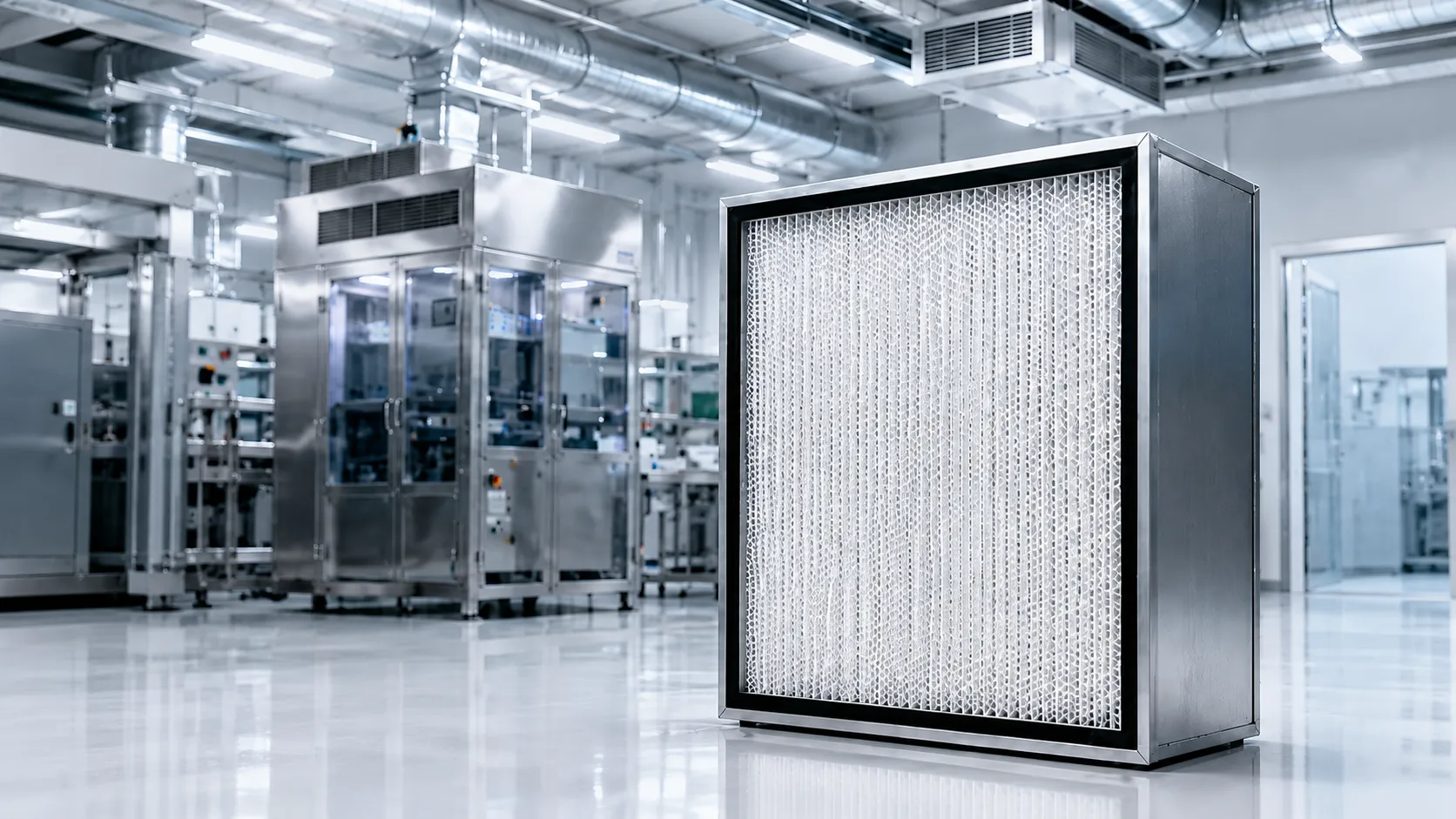
HEPA filters are high-efficiency air filtration products used in cleanrooms, hospitals, laboratories, pharmaceutical facilities, food production areas and industrial HVAC systems where airborne particle control is critical. However, selecting a product classified as a HEPA filter does not automatically guarantee that it is suitable for every application.
Filter class, airflow, pressure drop, frame material, sealing configuration, installation dimensions and operating conditions must be evaluated together. For this reason, an industrial HEPA filter should not be selected solely according to its dimensions or stated filtration efficiency.
What Is a HEPA Filter?
HEPA refers to a high-efficiency particulate air filtration class. Its primary purpose is to capture fine airborne particles within the filter media and support the delivery of cleaner air to controlled environments.
HEPA filters are not used only for visible dust. They are commonly installed in applications where microscopic particles may affect products, manufacturing processes, equipment, personnel or environmental conditions.
The filter media consists of a dense network of fine fibres. As air moves through this structure, particles are captured through several physical mechanisms, including interception, impaction and diffusion.
How Does a HEPA Filter Work?
Larger particles cannot always follow the airflow around the filter fibres and may collide with them. Medium-sized particles can be captured when they pass sufficiently close to a fibre and make contact with its surface.
Very small particles move in a less predictable manner and may therefore encounter filter fibres more frequently. The combined effect of these mechanisms enables a HEPA filter to capture particles across a broad particle-size range.
Filter testing pays particular attention to the Most Penetrating Particle Size, commonly known as MPPS. This is the particle-size range that is most difficult for the filter to capture. A HEPA classification should therefore be supported by testing conducted according to the applicable standard rather than by a general efficiency statement alone.
What Is the Difference Between H13 and H14 HEPA Filters?
H13 and H14 are among the most frequently specified HEPA classes in industrial and controlled-environment applications. H14 filters provide a higher particle capture efficiency than H13 filters. Nevertheless, the higher class is not automatically the most appropriate option for every air-handling system.
| Filter class | Overall efficiency at MPPS | Typical application approach |
|---|---|---|
| H13 | At least 99.95% | Cleanrooms, healthcare facilities, laboratories and sensitive HVAC applications |
| H14 | At least 99.995% | Critical production and controlled environments requiring a higher level of particle control |
The required filter class should be determined according to the facility risk assessment, process requirements, target cleanliness level and applicable technical standards. Specifying a higher class than necessary may increase system resistance and energy consumption without providing a meaningful operational advantage.
Key Criteria for Selecting an Industrial HEPA Filter
1. Application area
A pharmaceutical production facility, hospital, laboratory, food-processing plant and electronics manufacturing environment do not have identical filtration requirements. The expected contaminants, hygiene conditions and process risks must be identified before selecting the filter.
2. Required filter class
The decision between H13, H14 and ULPA filtration should not be based solely on the highest available efficiency. The selected class must correspond to the actual requirements of the application and the relevant technical specification.
3. Nominal airflow
The amount of air passing through the filter is one of the primary selection parameters. Using a filter with insufficient airflow capacity can increase face velocity, system resistance and pressure drop.
4. Initial pressure drop
Pressure drop represents the resistance created as air passes through the filter. A suitable filter with a controlled initial pressure drop can help the fan operate under more efficient conditions when combined with a properly designed ventilation system.
In addition to initial pressure drop, the recommended final pressure drop and the facility’s filter replacement criteria should also be reviewed.
5. Frame material
HEPA filters can be manufactured with MDF, galvanised steel, aluminium or stainless-steel frames. The correct frame material depends on humidity, temperature, hygiene requirements, chemical exposure and the configuration of the installation system.
6. Gasket or gel seal configuration
The seal between the filter and its housing is critical to overall filtration performance. Conventional gasket systems may be suitable for many HVAC applications, while gel seal HEPA filters are commonly considered for systems requiring controlled sealing through a liquid gel channel.
7. Dimensions and installation compatibility
Width, height and depth must be measured accurately. Gasket position, airflow direction, face protection, frame thickness and the structure of the filter housing should also be confirmed before ordering.
Where standard dimensions do not fit the existing system, custom HEPA filters can provide compatibility without requiring the entire air-handling installation to be replaced.
8. Testing and documentation
In critical applications, testing documentation is as important as the stated filter class. Applicable standards, test methods, product labels, technical data sheets and any project-specific test report requirements should be clarified during procurement.
Where Are HEPA Filters Used?
- Pharmaceutical and biotechnology facilities
- Hospitals and healthcare environments
- Laboratories and research centres
- Cleanrooms and controlled production areas
- Food and beverage manufacturing facilities
- Electronics and semiconductor production
- Industrial HVAC systems
- Fan filter units and terminal filtration systems
Each industry has different particle-control, hygiene, airflow and maintenance requirements. The same filter model may therefore provide different service life and operating results in different facilities.
Common HEPA Filter Selection Mistakes
- Selecting a filter only by its external dimensions
- Ignoring nominal airflow and pressure drop
- Specifying the highest filter class for every application
- Failing to check gasket position and housing compatibility
- Ignoring operating temperature and humidity
- Confusing a general product certificate with an individual filter test report
- Overlooking the importance of pre-filtration
- Planning replacement only according to a fixed calendar interval
An inadequate pre-filtration stage can cause the HEPA filter to load more quickly. This may result in an earlier increase in pressure drop and a shorter operating life.
When Should a HEPA Filter Be Replaced?
There is no single replacement interval suitable for every facility. Replacement decisions should consider pressure-drop readings, operating time, process requirements, hygiene risks, physical condition and relevant test results.
Technical inspection is recommended when frame deformation, media damage, seal failure or an unexpected rise in pressure drop is detected.
Why Choose a Custom HEPA Filter?
Existing ventilation systems may contain non-standard filter housings, specific gasket positions or project-specific airflow requirements. Custom HEPA filter manufacturing allows dimensions, materials and sealing configurations to be adapted to the installation.
Safe Air develops industrial HEPA filter solutions with different frame options and project-specific dimensions. Application area, filter class, dimensions, airflow, frame material and sealing requirements are considered together during product evaluation.
Identify the Right HEPA Filter for Your Project
Providing the required width, height, depth, nominal airflow, filter class, frame material, seal type and order quantity helps accelerate the technical evaluation and quotation process.
Review Safe Air’s industrial HEPA filter solutions or request a technical quotation for standard and custom filter requirements.
Frequently Asked Questions
No. Selecting a product classified as a HEPA filter does not automatically make it suitable for every application. Filter class, airflow, pressure drop, frame material, sealing, dimensions and operating conditions must be evaluated together.
Application area, required filter class, nominal airflow, initial pressure drop, frame material, gasket or gel seal configuration, installation dimensions, and the testing and documentation supplied with the filter.
No. The article states explicitly that an industrial HEPA filter should not be selected solely according to its dimensions or its stated filtration efficiency.
Because the filter has to seal in its housing to reach its rated performance. The article lists the gasket or gel seal configuration as a separate selection criterion alongside the filter class.
When standard dimensions, frame materials or sealing options do not match the installation. A custom filter keeps the installation fit and sealing intact instead of forcing a standard product into the housing.