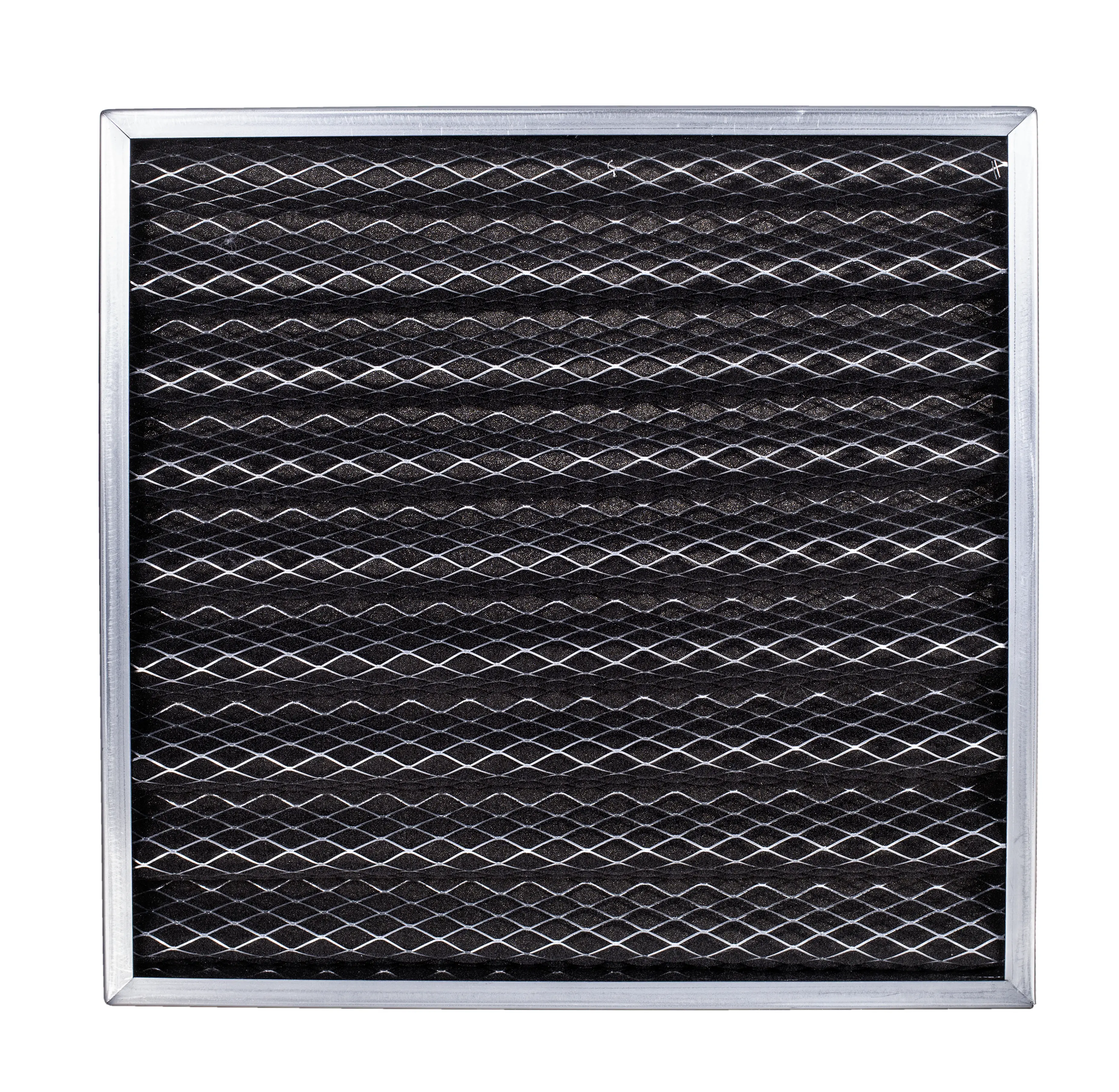
The Short Answer: Activated Carbon Captures Gases, Not Particles
An activated carbon cassette filter works on different physics from every other cassette filter. Coarse, medium and HEPA filters capture solid particles mechanically. Activated carbon captures no particles at all; it separates gas molecules from the air by adhesion to the carbon surface — adsorption.
In practice this means an activated carbon filter does not substitute for a dust filter, and a dust filter does not solve an odour problem. The two are successive and complementary stages.
How Adsorption Happens
Activated carbon is a form of carbon processed with micro-pores. That pore structure gives a typical surface area of 800–1,200 m² per gram — a handful of carbon holds an internal surface the size of several football pitches.
Gas molecules adhere to this surface through weak intermolecular forces (van der Waals). This is physical adsorption. The molecule is not chemically altered; it simply attaches to the surface and stays there.
Some gases are not held adequately by physical adsorption. For these the carbon is used in impregnated form: a chemical added to the surface reacts with the target gas and binds it. This second mechanism is chemical adsorption and is gas-selective — the impregnation is chosen for the gas to be removed.
Which Gases Does It Capture, and Which Not?
The effectiveness of activated carbon depends on molecular size and volatility:
- Well captured: Volatile organic compounds (VOCs), solvent vapours, organic odours from kitchens and waste, exhaust-derived hydrocarbons, ozone.
- Requires impregnated carbon: Hydrogen sulphide (H₂S), ammonia (NH₃), formaldehyde, acidic gases. Standard carbon performs poorly against these.
- Not captured: Very small, low boiling point molecules such as methane, carbon monoxide, nitrogen and oxygen. Carbon monoxide matters particularly: an activated carbon filter offers no protection against CO.
That last point is critical for safety. An activated carbon filter is an odour and VOC solution; it does not replace a gas detector or fresh air supply where breathable air safety is required.
The Most Important Difference: Carbon Saturates Without Any Rise in Pressure Drop
This is the most widely misunderstood aspect of activated carbon filters in operation, and it leads directly to maintenance error.
As a dust filter loads, its pores block, pressure drop rises, and the gauge tells you the filter is due for replacement. Activated carbon gives no such indication. Gas molecules do not physically block the pores; they only adhere to the surface. Even when the carbon is fully saturated, pressure drop remains almost exactly what it was on day one.
A saturated filter stops capturing gas while air continues to pass through it without resistance. This is called breakthrough. Worse, if temperature rises or concentration falls, some captured molecules can be released again — the filter can give the odour back.
Replacement of an activated carbon filter therefore cannot be decided by pressure drop. For filter types where pressure drop monitoring does apply, see HEPA filter pressure drop.
So When Should It Be Replaced?
Replacement of an activated carbon filter is determined by one of three methods:
- By odour: The simplest and most common method. When odour becomes perceptible downstream of the filter, breakthrough has occurred. Simple, but a late indicator.
- By calculated life: Where carbon mass, gas concentration and airflow are known, an estimated saturation time can be calculated and replacement planned accordingly.
- By measurement: In critical applications, VOC or target gas concentration is measured before and after the filter.
In industrial applications carbon cannot be regenerated on site. Regeneration requires high-temperature steam or thermal treatment and is not possible in a facility. Heating or washing the carbon does not recover the filter and usually releases the captured gas back into the environment.
Four Factors That Determine Performance
1. Contact Time
The time a gas molecule spends in the carbon bed directly determines the probability of capture. Contact time is found as bed depth ÷ face velocity. In thin panel-type carbon filters this time is short, which is why thin panels suit general odour control rather than high-concentration process gas.
Where high concentration or high removal efficiency is required, a deeper bed or cartridge-type solution is preferred. For those applications see activated carbon cartridge filters.
2. Carbon Quantity
Filter life is directly proportional to the mass of carbon it contains. Two activated carbon filters of identical outer dimensions can differ markedly in carbon content. When comparing quotations, the right question is "how many kilograms of carbon does the filter contain?"
3. Humidity
Water molecules also adhere to the carbon surface and compete for the same pores as the target gas. Above 70% relative humidity, adsorption capacity falls noticeably. In humid environments a carbon filter saturates far sooner than expected.
4. Temperature
Physical adsorption weakens as temperature rises. In a warm airstream the carbon both captures less and may release molecules it captured earlier.
A Pre-Filter Is Mandatory
A particle pre-filter must always be installed ahead of an activated carbon filter. Dust reaching the carbon physically closes the pore mouths and prevents gas from reaching the internal surface. Most of the carbon goes unused and the filter becomes ineffective.
This is even more critical in greasy environments: oil aerosol coats the carbon surface and all but stops adsorption. For pre-stage selection see cassette filters, and for class selection our ISO 16890 vs EN 779 comparison.
Where Are They Used?
- Kitchen and restaurant exhaust: Odour removal after grease and particle stages.
- Wastewater and treatment plants: Impregnated carbon for H₂S.
- Paint and coating facilities: Solvent vapour and VOCs.
- Laboratory and hospital ventilation: Chemical and disinfectant vapours.
- Airport and car park ventilation: Exhaust-derived hydrocarbons and odour.
- Office and shopping centre fresh air systems: Urban pollution and odour in outdoor air.
Safe Air Activated Carbon Solutions
Safe Air manufactures activated carbon filters in cassette, compact and cartridge form. See activated carbon cassette filters, activated carbon compact filters and activated carbon cartridge filters.
For the carbon type and bed depth suited to your target gas, concentration and airflow, contact us.
Frequently Asked Questions
Activated carbon is a form of carbon processed with micro-pores, giving a typical surface area of 800–1,200 m² per gram. Gas molecules adhere to that surface through weak intermolecular forces, a process called physical adsorption. It captures no particles; it separates only gases and odours.
Not by pressure drop. Because gas molecules do not physically block the pores, pressure drop remains at its day-one value even when the carbon is fully saturated. Replacement is determined by odour becoming perceptible downstream, by a calculated life based on carbon mass and gas concentration, or by measuring gas concentration before and after the filter.
Very small, low boiling point molecules such as methane, carbon monoxide, nitrogen and oxygen are not captured. Carbon monoxide matters particularly: an activated carbon filter offers no protection against CO. Standard carbon is also inadequate for hydrogen sulphide, ammonia and formaldehyde, which require impregnated carbon.
Yes. Dust reaching the carbon physically closes the pore mouths and prevents gas from reaching the internal surface, leaving most of the carbon unused and the filter ineffective. This is even more critical in greasy environments, where oil aerosol coats the carbon surface and all but stops adsorption.
Yes, markedly. Water molecules also adhere to the carbon surface and compete for the same pores as the target gas. Above 70% relative humidity, adsorption capacity falls and the filter saturates far sooner than expected. High temperature likewise weakens adsorption and can cause captured molecules to be released.