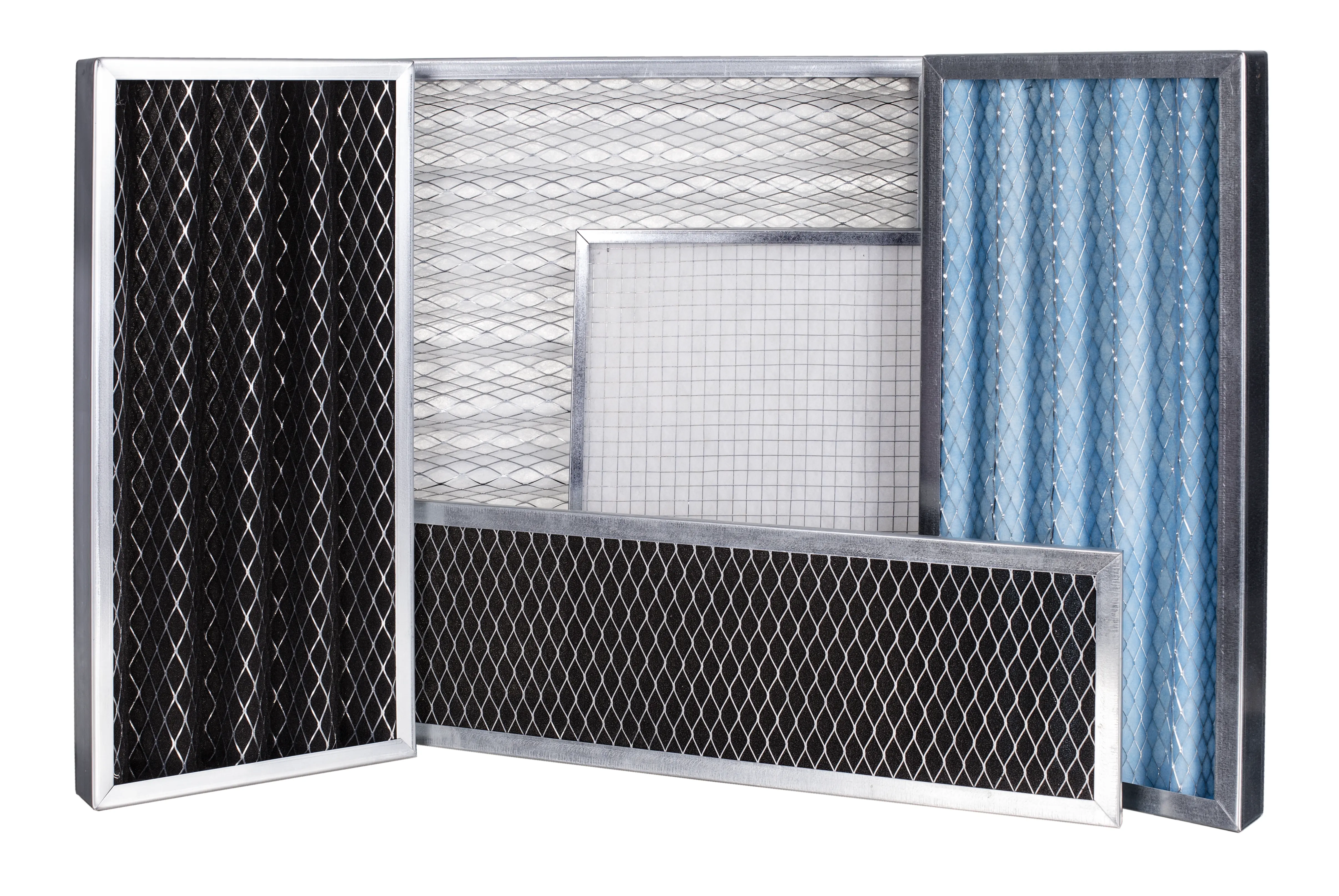
What Is a Cassette Filter? A Direct Answer
A cassette filter is an air filter of square or rectangular section, formed by holding filter media inside a rigid frame — either stretched flat or arranged in pleats. In ventilation systems it usually serves as the first stage, capturing coarse dust, fibres, pollen and large particles to protect the more expensive filters behind it.
It is also called a panel filter. What defines a cassette filter is not its efficiency but its form — the same cassette body can be built to efficiencies ranging from coarse to fine, depending on the media placed inside it.
How a Cassette Filter Works
A cassette filter does not capture particles by sieving alone. The gaps between media fibres are considerably larger than most of the particles it captures. Capture occurs through four mechanisms:
- Sieving: Particles larger than the fibre gap are blocked directly.
- Inertial impaction: Heavier particles cannot follow the airflow as it curves around a fibre and strike the fibre instead.
- Interception: Particles that follow the streamline but pass close enough adhere to the fibre surface.
- Diffusion: Very small particles move erratically through Brownian motion and contact the fibres.
Cassette filters become more efficient as they load, while their pressure drop also rises. The captured dust layer acts as additional filter surface, but that same layer impedes airflow. This is why the replacement decision is made by pressure drop rather than by calendar.
Why Pleated (Z-Type) Construction Is Used
If media is stretched flat, the media area equals the face area of the frame. If the media is pleated in a zigzag, several times more media area fits into the same frame.
The practical consequence is that face velocity through the media falls at the same airflow. Lower face velocity means lower pressure drop, greater dust holding capacity and longer service life. This is why Z-type (zigzag) cassette filters are generally preferred over flat panels.
Pleat depth and pleat count directly determine the filter's nominal airflow and initial pressure drop. For a detailed comparison of the two constructions, see Z-type cassette filter vs flat panel filter.
Media Types Used in Cassette Filters
- Synthetic (polyester / PET) media: The most common option. Moisture tolerant and economical, used in coarse and medium classes.
- Glass fibre media: Achieves higher efficiency through a finer fibre structure; more sensitive to moisture than synthetic media.
- Polyurethane foam (PPI): Pore density is expressed in pores per inch. Preferred in paint booths and pre-stages for its washability and mechanical strength.
- Metal (aluminium / stainless) labyrinth: Used in kitchen hood grease filters, where washability and non-combustibility are mandatory.
- Activated carbon layered media: Captures gases and odours rather than particles; its operating principle is entirely different.
Frame Materials
- Cardboard: The most economical option, suitable for dry, room-temperature applications; not used in humid environments.
- Galvanised steel: A durable industrial standard, tolerant of moisture and mechanical load.
- Plastic (ABS / polystyrene): Light and corrosion resistant; common in fan coil and small equipment applications.
- Aluminium: Combines low weight with corrosion resistance; advantageous where filters are changed frequently.
Frame choice is usually dictated by ambient conditions rather than price. In a humid air handling unit a cardboard frame disintegrates and the media separates from the housing — which produces the same result as running with no filter at all.
Which Classes Are Cassette Filters Made In?
Cassette filters are typically produced in the coarse and medium efficiency range. Under the former EN 779 classification this corresponds to G3, G4, M5, M6 and partly F7. That standard was withdrawn in 2018 and replaced by ISO 16890, which reports efficiency against the PM10, PM2.5 and PM1 fractions.
There is no exact conversion table between the two standards; a filter's ISO 16890 class can only be established by retesting. For the detail of classification, see G4, M5, F7 filter classes: ISO 16890 vs EN 779 compared.
High-efficiency filtration (H13, H14) is not provided by a cassette body but by a separate product family. The HEPA classes fall under EN 1822 and do not substitute for a cassette filter — the two work as successive stages in the same system.
Where Are Cassette Filters Used?
- Air handling units (AHU): As the first stage, protecting bag, compact or HEPA filters.
- Fan coil units: Shallow flat or pleated types.
- Kitchen hoods: Metal grease filters, mandatory for fire safety.
- Paint booths: Polyurethane foam and synthetic media for overspray capture.
- Industrial production facilities: Pre-stage in process air and general ventilation.
- Cleanroom and hospital systems: Protective pre-filter ahead of the HEPA stage.
The Economic Value of a Cassette Filter as a Pre-Filter
The real function of a cassette filter in a system is less about itself than about protecting the filter behind it. A HEPA filter costs many times the unit price of a cassette filter. When the pre-stage is neglected, coarse dust reaches the HEPA directly, pressure drop rises rapidly, and the expensive filter is replaced far earlier than necessary.
In a correctly configured system, the cheap component is replaced often and the expensive one rarely. Economising on the pre-filter stage does not lower total filtration cost — it raises it.
Safe Air Cassette Filter Solutions
Safe Air manufactures synthetic, polyurethane, cardboard-framed and metal grease cassette filters in standard sizes and to project-specific dimensions. Review the range on our cassette filters page, and for gas and odour applications see activated carbon cassette filters.
For the class, size and media suited to your system, contact us.
Frequently Asked Questions
A cassette filter is an air filter of square or rectangular section formed by holding filter media inside a rigid frame. It is also called a panel filter. In ventilation systems it usually serves as the first stage, capturing coarse dust, fibres and pollen to protect the more expensive filters behind it.
No, these are two names for the same product. In the industry the terms are used interchangeably. The meaningful distinction is not the filter type but whether the media is flat or pleated (Z-type / zigzag).
Cassette filters are typically produced in the coarse and medium efficiency range, corresponding to G3, G4, M5, M6 and partly F7 under the former EN 779 classification. That standard was replaced by ISO 16890 in 2018. HEPA classes such as H13 and H14 are not provided by a cassette body but by a separate family covered by EN 1822.
When media is pleated in a zigzag, several times more media area fits into the same frame. This lowers the face velocity through the media at the same airflow, which results in lower pressure drop, greater dust holding capacity and longer service life.
The replacement decision is made by pressure drop, not by calendar. The initial pressure drop is recorded when the filter is installed and rises as it loads; the filter is replaced when the manufacturer's recommended final pressure drop is reached. Visible damage, wetting or separation from the frame requires replacement regardless of elapsed time.