The Short Answer: The Difference Is Not the Media but the Media Area
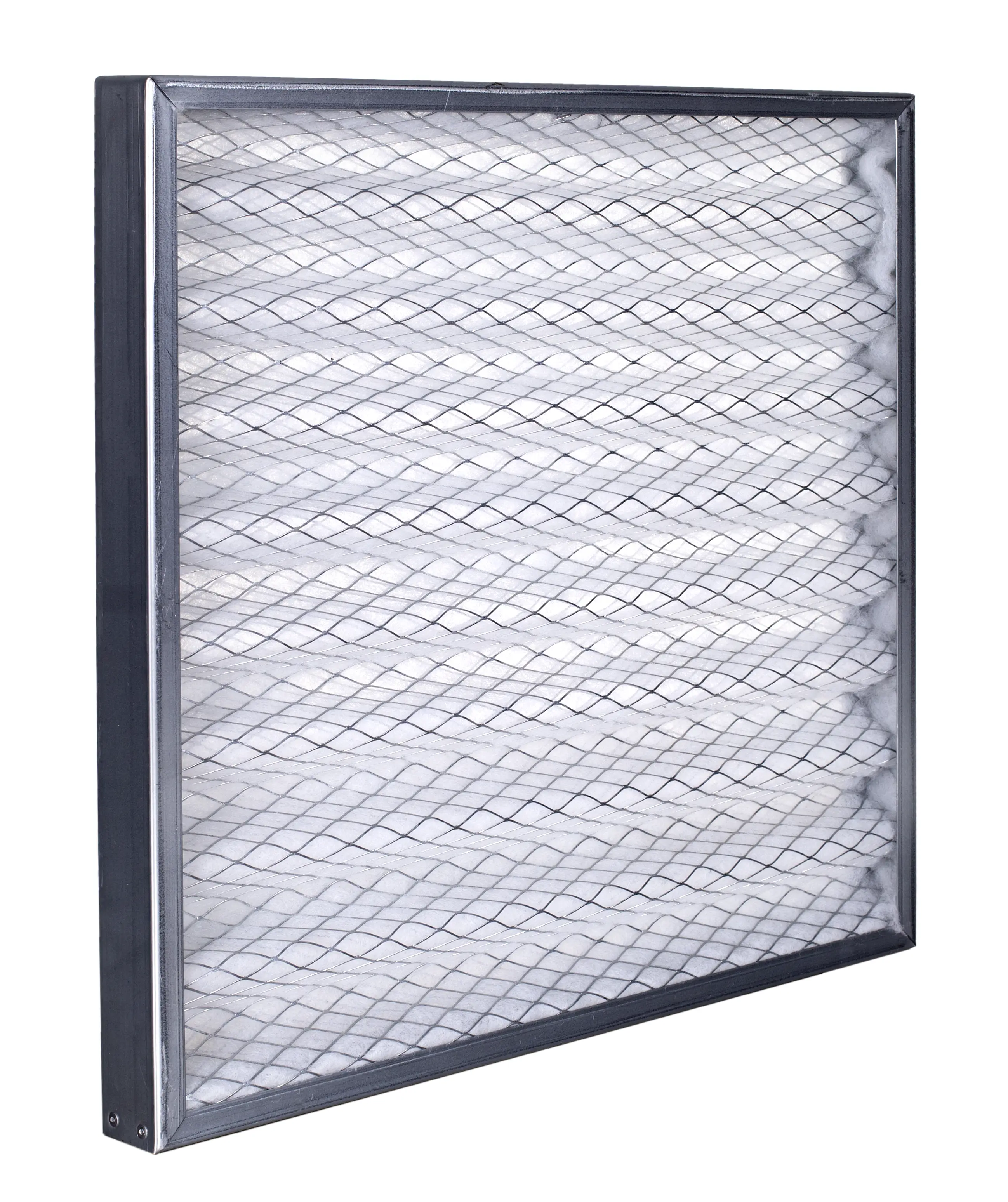
A Z-type (zigzag) cassette filter and a flat panel filter can be made from the same media and can share the same filter class. What separates them is not media quality but how much media is packed into the same frame.
In a flat panel the media area equals the face area of the frame. In Z-type pleated construction the media is folded in a zigzag, so several times more media fits the same frame. The result is lower pressure drop, greater dust holding capacity and longer service life.
How Media Area Is Calculated
For a pleated filter, media area is approximated by:
Media area ≈ Face area × 2 × (pleat depth ÷ pleat pitch)
Made concrete: a 592 x 592 mm filter has a face area of roughly 0.35 m².
- Flat panel: Media area ≈ 0.35 m². There is no other option.
- 48 mm depth, 12 mm pleat pitch: 2 × (48 ÷ 12) = 8× → media area ≈ 2.8 m².
- 96 mm depth, 20 mm pleat pitch: 2 × (96 ÷ 20) = 9.6× → media area ≈ 3.4 m².
At the same outer dimensions, then, pleated construction holds eight to ten times the media of a flat panel. That explains why a construction difference which looks minor on paper produces such a large difference in performance.
Face Velocity: The Governing Factor
Media area matters because it sets face velocity — the speed at which air passes through the media, found as airflow ÷ media area.
The same airflow passes through 0.35 m² in a flat panel and through 2.8 m² in a pleated one. Velocity through the media therefore falls to roughly one eighth. Low face velocity has three consequences:
- Pressure drop falls. The fan delivers the same airflow with less energy.
- Efficiency rises. A particle moving slowly is more likely to adhere to a fibre; the diffusion mechanism in particular becomes more effective as velocity falls.
- Re-entrainment decreases. At high face velocity captured particles can detach and rejoin the airstream; pleated construction reduces that risk.
Dust Holding Capacity and Service Life
A filter is replaced when dust accumulated on its media has raised pressure drop to the limit value. If the media area is eight times larger, the same quantity of dust spreads over eight times the area and pressure drop rises far more slowly.
In practice this means that where a flat panel clogs within weeks, a pleated filter in the same environment can run for months. Because the change interval lengthens, both filter cost and change labour fall.
For pressure drop monitoring and its cost relationship, see cassette filter prices.
Comparison Table
| Criterion | Flat panel filter | Z-type (zigzag) pleated |
|---|---|---|
| Media area (592x592) | ≈ 0.35 m² | ≈ 2.8–3.4 m² |
| Face velocity | High | Roughly one eighth |
| Initial pressure drop | High | Markedly lower |
| Dust holding capacity | Low | High |
| Service life | Short | Long |
| Unit price | Low | Higher |
| Minimum depth | 10–25 mm | 45 mm and above in practice |
| Achievable class | Usually coarse (ISO Coarse) | Coarse through to ePM1 |
How Tight Should the Pleat Pitch Be?
The formula suggests that tighter pleats are always better. In reality there is an optimum.
When pleats are packed too tightly, adjacent pleat faces shadow one another: air barely reaches the media at the base of each pleat and that area takes no part in filtration. Narrow channels also encourage dust bridging, so the filter clogs before reaching its nominal capacity.
For this reason, compare not the catalogue media area figure but the initial pressure drop at nominal airflow and the dust holding capacity. These already account for the shadowing effect.
When Is a Flat Panel the Right Choice?
Pleated construction is superior in most applications, but flat panels retain their place in several cases:
- Very shallow slots. Pleating is impractical at 20–25 mm depth, which is why fan coil units generally use flat or very shallow pleated filters.
- Low airflow, clean environments. Where the dust load is light, the surplus capacity of pleated construction may not repay itself.
- Washable metal filters. Grease filters in kitchen hoods use a labyrinth construction; the principle here is inertial separation of grease, not pleating.
- Polyurethane foam applications. In paint booths a foam sheet holds overspray within its volume, and pleating offers no advantage.
Which Product Should I Choose?
The decision reduces to three questions:
- How deep is the slot? Below 45 mm the choice is already a flat or shallow pleated filter.
- What is the dust load? Where it is heavy, pleated construction repays itself in labour and energy.
- Where does the filter sit in the staging? If an expensive filter follows it, building a strong pre-stage lowers total cost.
Safe Air manufactures Z-type pleated, polyurethane and flat type cassette filters. See flat type filters and Z type polyurethane (PPI) filters, or the full range on our cassette filters page.
For the construction and class suited to your system, contact us.
Frequently Asked Questions
Both can be made from the same media and share the same class; the difference is not media quality but the media area packed into the same frame. In a flat panel the media area equals the face area, while Z-type pleating folds the media in a zigzag so that eight to ten times more media fits.
Approximately: media area = face area × 2 × (pleat depth ÷ pleat pitch). For a 592 x 592 mm filter at 48 mm depth with a 12 mm pleat pitch the multiplier is 8, so a face area of 0.35 m² corresponds to roughly 2.8 m² of media area.
Because the media area is around eight times larger, the same quantity of dust spreads over eight times the area and pressure drop rises far more slowly. Since a filter is replaced when it reaches its limit pressure drop, pleated construction runs markedly longer in the same environment.
No, there is an optimum. When pleats are packed too tightly, adjacent faces shadow one another: air barely reaches the media at the base of each pleat, so that area takes no part in filtration. Narrow channels also encourage dust bridging. Compare initial pressure drop at nominal airflow and dust holding capacity rather than the media area figure.
Where the slot is very shallow, at 20–25 mm, pleating is impractical, which is why fan coil units use flat or very shallow pleated filters. Flat construction is also correct in low-airflow clean environments, in washable metal labyrinth filters for kitchen hoods, and in polyurethane foam applications for paint booths.