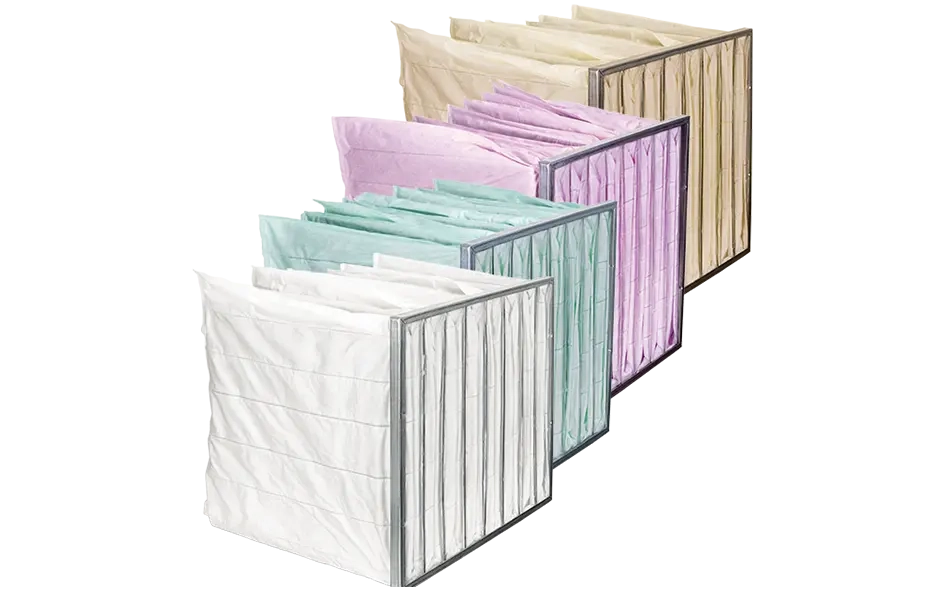
Bag Filters

M5 M6 Bag Filters
M5 and M6 pocket filters for the medium stage, or as a pre-filter ahead of a fine stage. The housing has to leave room for the pockets to inflate.
Check out the product
F7 F8 Bag Filters
F7 and F8 pocket filters for the fine stage of an air handling unit, the usual choice ahead of a HEPA stage. Pocket count and depth decide the selection.
Check out the product
F9 Bag Filter
F9 pocket filters for the fine stage of an air handling unit, where outdoor air quality or the process asks for more than F7 or F8.
Check out the productBag filters — also called pocket filters — are the most widely used main filter stage in air handling units. Several pockets of media hang from a common header, giving a large media area in a relatively small face. That area is what keeps the pressure drop low while the filter loads with dust.
This page covers selection. For the current models see M5 M6 bag filters, F7 F8 bag filters and F9 bag filters; for the coarse stage ahead of them see G3 G4 coarse bag filters.
Which Class
Bag filters are classified under EN ISO 16890 as ISO ePM10, ISO ePM2.5 or ISO ePM1, with the efficiency stated in 5% steps. The former EN 779 labels — M5, M6, F7, F8, F9 — are still in everyday use and still appear in specifications, but EN 779 was withdrawn on 11 July 2018 and the two standards do not convert one to one.
As a reading guide rather than a conversion:
| Former label | Typically specified as | Usual duty |
|---|---|---|
| M5 · M6 | ISO ePM10 | Medium stage, or pre-filter ahead of a fine stage |
| F7 | ISO ePM1 | Main stage; the usual choice ahead of a HEPA stage |
| F8 · F9 | ISO ePM1, higher step | Main stage where outdoor air quality or the process demands it |
This table helps you read a specification. It does not establish the class of any particular filter — that comes from the test report for the model you are buying. Our guide on G4, M5, F7 filter classes explains why.
What Actually Drives the Selection
Pocket count and depth. More pockets and greater depth mean more media area. More area at the same airflow means a lower initial pressure drop and a longer run before the final pressure drop is reached. The limit is the housing: the pocket needs room to inflate without touching the next filter or the casing.
Airflow per filter. The class tells you nothing about pressure drop on its own. The same filter at double the airflow is a different proposition. Every pressure drop figure has to come with the airflow it was measured at.
Dust loading. A filter in a high-dust intake reaches its final pressure drop faster. Where loading is heavy, a coarse stage ahead of the bag filter usually costs less than changing the bag filter more often.
Humidity. Synthetic media in a damp airstream behaves differently from the same media in a dry one, and a wet pocket can sag onto its neighbour. Tell us the humidity in operation and at shutdown.
Discharged efficiency. Ask for it. See the next section.
Electrostatic Charge: a Question, Not a Feature
Synthetic bag filter media is commonly charged electrostatically. The charge improves measured efficiency on a new filter and then fades in service as humidity and captured particulate neutralise it.
This is why ISO 16890 repeats the measurement on discharged media and reports that value too. For a purchasing decision the discharged figure is the more useful one, because it is closer to what the filter delivers across its service life.
When you receive a quotation, ask which value is quoted. If only the initial figure is given, the comparison between two offers may not mean what it appears to mean.
Bag Filter or Compact Filter
Both do the same filtration duty. The difference is mechanical.
| Bag filter | W compact filter | |
|---|---|---|
| Housing depth | Needs depth for the pockets to inflate | Shorter, rigid body |
| Frame | Flexible pockets on a header | Rigid frame, holds its shape |
| High or pulsing airflow | Pockets can flutter | Rigid body is more stable |
| Damp airstream | Pockets can sag | Rigid body is less affected |
| Service handling | Lighter, folds | Bulkier, holds shape |
Which is right depends on the housing you have and the airflow regime, not on one being better. If you are not sure, send the housing dimensions and the design airflow and we will tell you which fits. See W compact filters for that format.
Common Ordering Mistakes
- Giving a class without an airflow — the pressure drop cannot be evaluated
- Giving the housing opening dimensions as the filter dimensions, or the reverse
- Specifying depth from the old filter without checking whether the pockets had room to inflate
- Comparing an initial efficiency figure against a discharged one
- Removing the pre-filter to save cost, then changing the main stage twice as often
What We Need to Quote
Filter class or application · width × height × depth with units · whether those are filter or housing dimensions · design airflow per filter with units · acceptable initial pressure drop · final pressure drop for changeover · number of pockets if specified · housing type and clamping · operating temperature and humidity · quantity and estimated annual quantity · destination country.
If you only have the filter currently fitted, send a photograph of its label and the housing opening dimensions.